Today's Hours:
9 a.m. – 5 p.m.

Siebel Dinosaur Complex

Siebel Dinosaur Complex

Primary Exhibit

OPEN YEAR-ROUND

Step into the ancient world at the Siebel Dinosaur Complex.

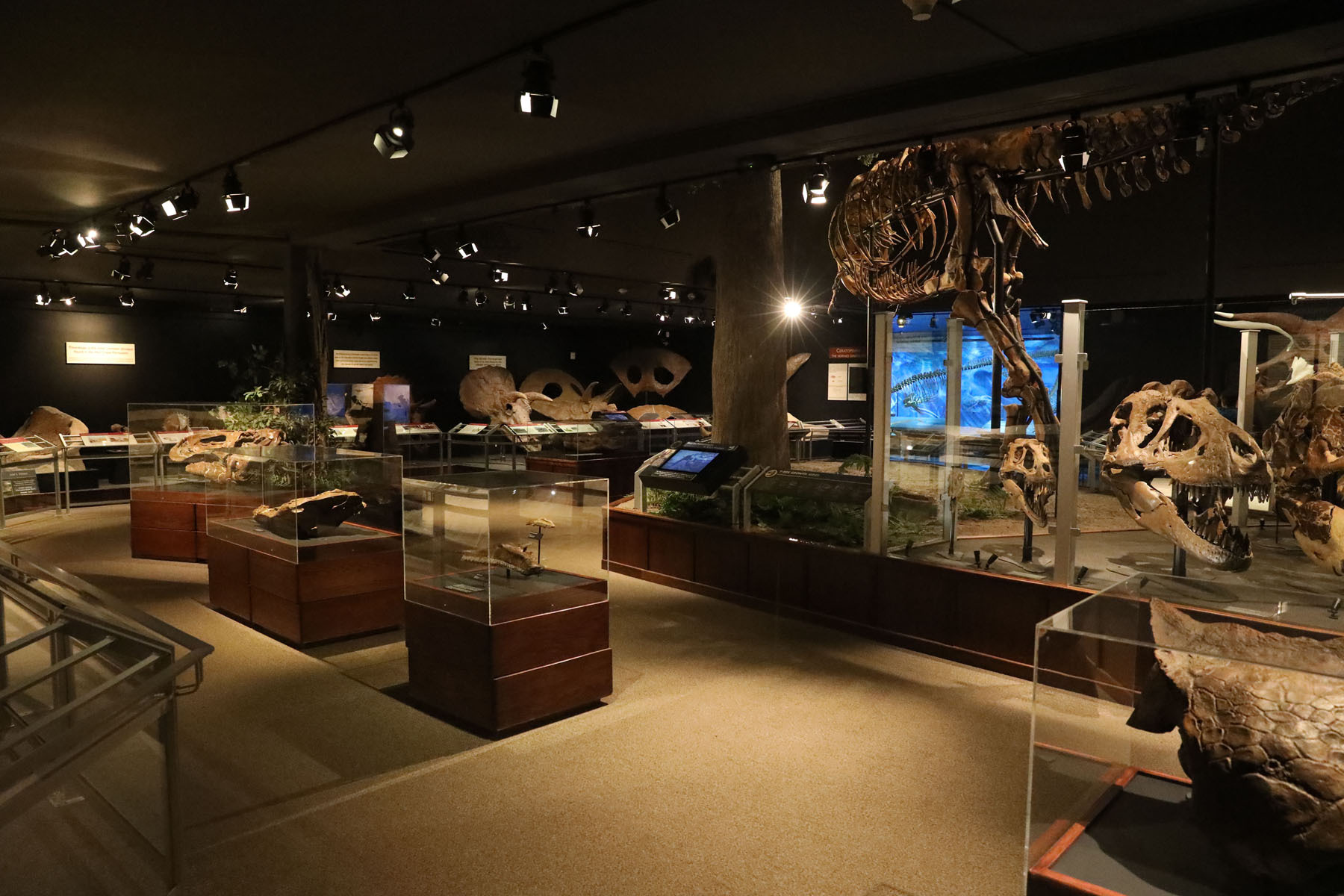
Museum of the Rockies (MOR) is a center of active research and exploration into the ancient past. Fossils have been found across much of Montana and the paleontology department at MOR is dedicated to researching the deep past of the state and surrounding regions. Within the museum’s walls is one of the largest collections of North American dinosaurs in the world, including many examples of the gigantic carnivorous Tyrannosaurus rex and a growth series of the horned Triceratops which ranges from juveniles to giants.
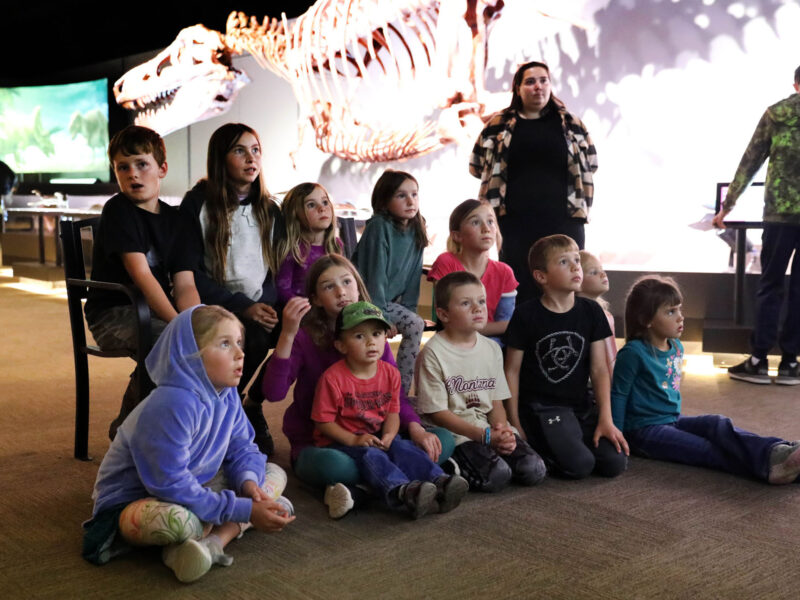
Many of these fossils are on display in the museum’s Siebel Dinosaur Complex, where visitors can view Montana’s T. rex, one of the few mounted Tyrannosaurus rex skeletons in the United States, the bones of "Big Al", a nearly complete Allosaurus that lived during the Jurassic Period, numerous dinosaur eggs and babies, and more.

In addition to dinosaurs, the museum contains a large collection of prehistoric mammals that once roamed the state, including mammoths, rhinos, and bone-crushing dogs. These fossils and more are on exhibit in the Siebel's Cenozoic Corridor.

“The dinosaur exhibits are jaw-dropping—so well done and fascinating for all ages. The T. rex and fossils alone make it worth the visit. A true Bozeman gem!”

-R (Google Review)

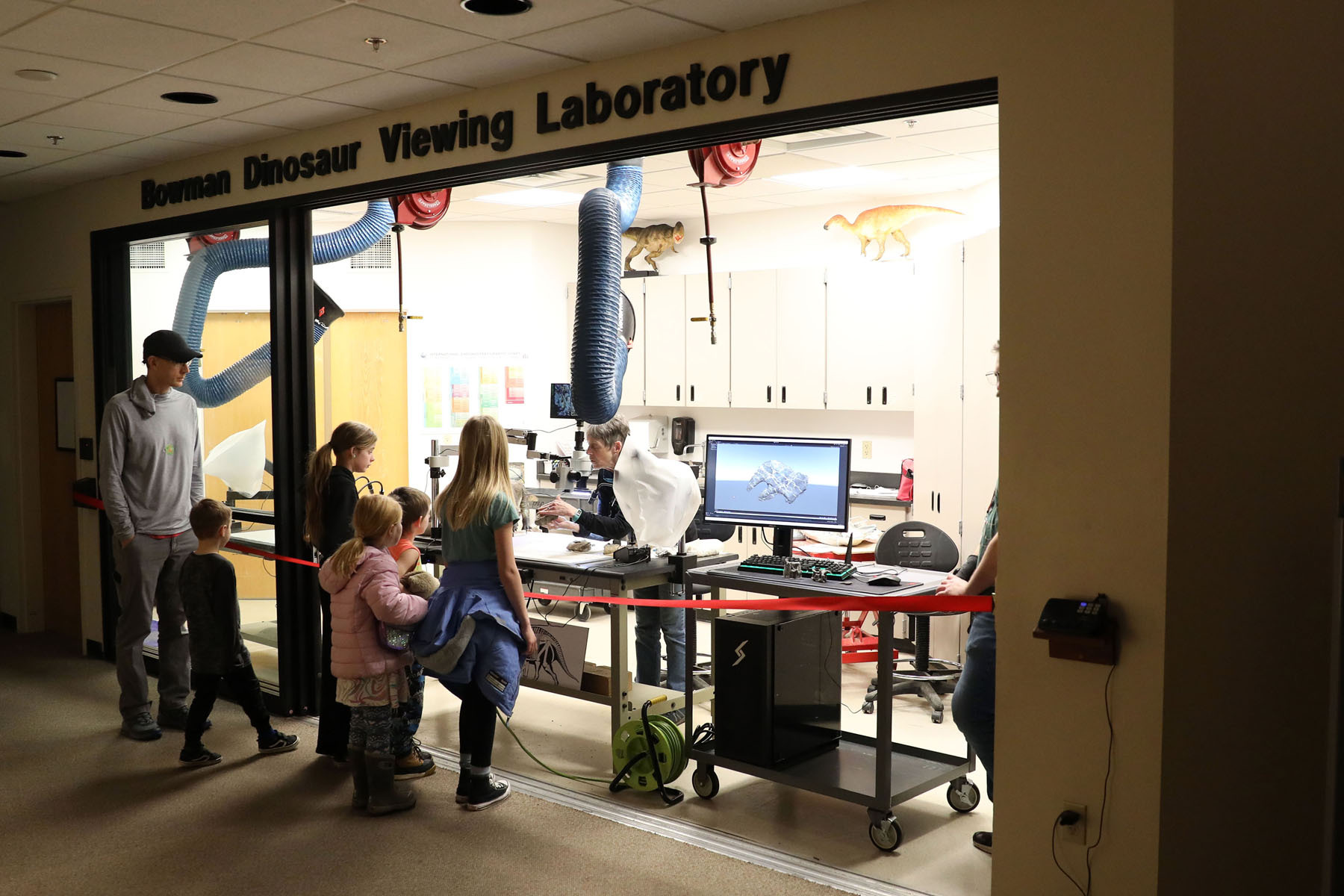
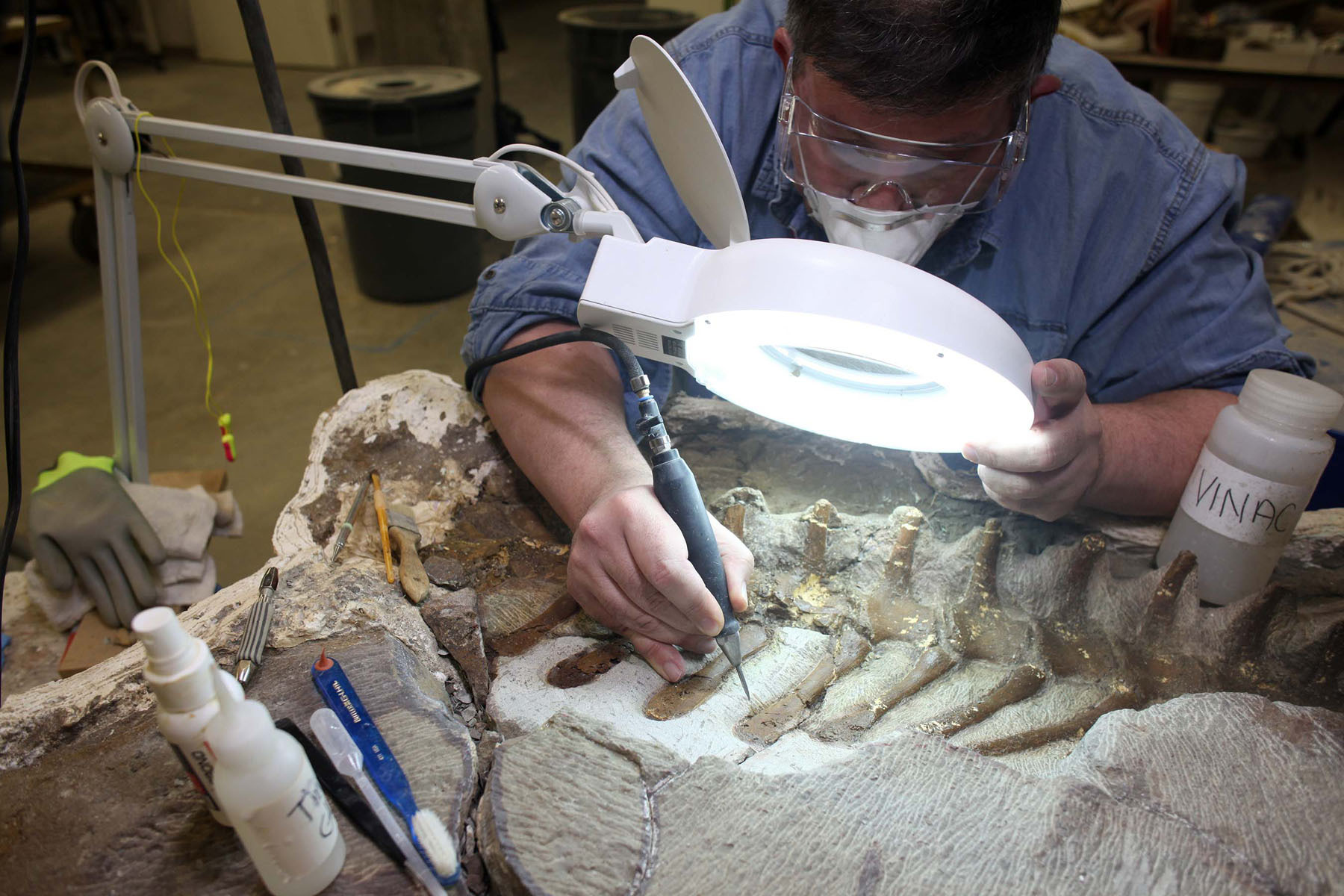
Visitors to the museum can see fossil preparators at work in the Bowman Dinosaur Viewing Lab where they carefully remove the rock that has encased fossils for millions of years so that the specimens can be studied. Every day, new discoveries are being made at MOR.

Each year, the paleontology field crew sets off into the rocky outcrops of the Treasure State in order to collect more information about what the world was like millions of years ago and how it and the creatures that have inhabited it have changed through time.

This data-rich exhibit engages visitors in the science of paleontology: how we know what we think we know about dinosaurs. At every turn, you will encounter the latest research on life in the Mesozoic Era, abundantly evident in Montana, as well as the processes of research. Visitors are challenged to formulate their own hypotheses about dinosaur growth, development, behavior, and interactions with their environments. As new discoveries and scientific breakthroughs are made, visitors will see changes in the exhibit.

The Siebel Dinosaur Complex houses the Dinosaurs Under The Big Sky exhibit, one of the largest and most up-to-date dinosaur exhibits in the world. In 2003, Thomas and Stacey Siebel donated $2 million to help triple the museum's dinosaur exhibit space. They were impressed by the museum's user-friendly approach to explaining complex concepts, especially for children. The Siebel Dinosaur Complex was built based on the children's book Dinosaurs Under the Big Sky authored by renowned paleontologist and MOR's former Curator of Paleontology Jack Horner, who also contributed to the exhibit's design.

The new exhibit, Cretaceous Crossroads, opened in early July 2025.

Landforms & Lifeforms

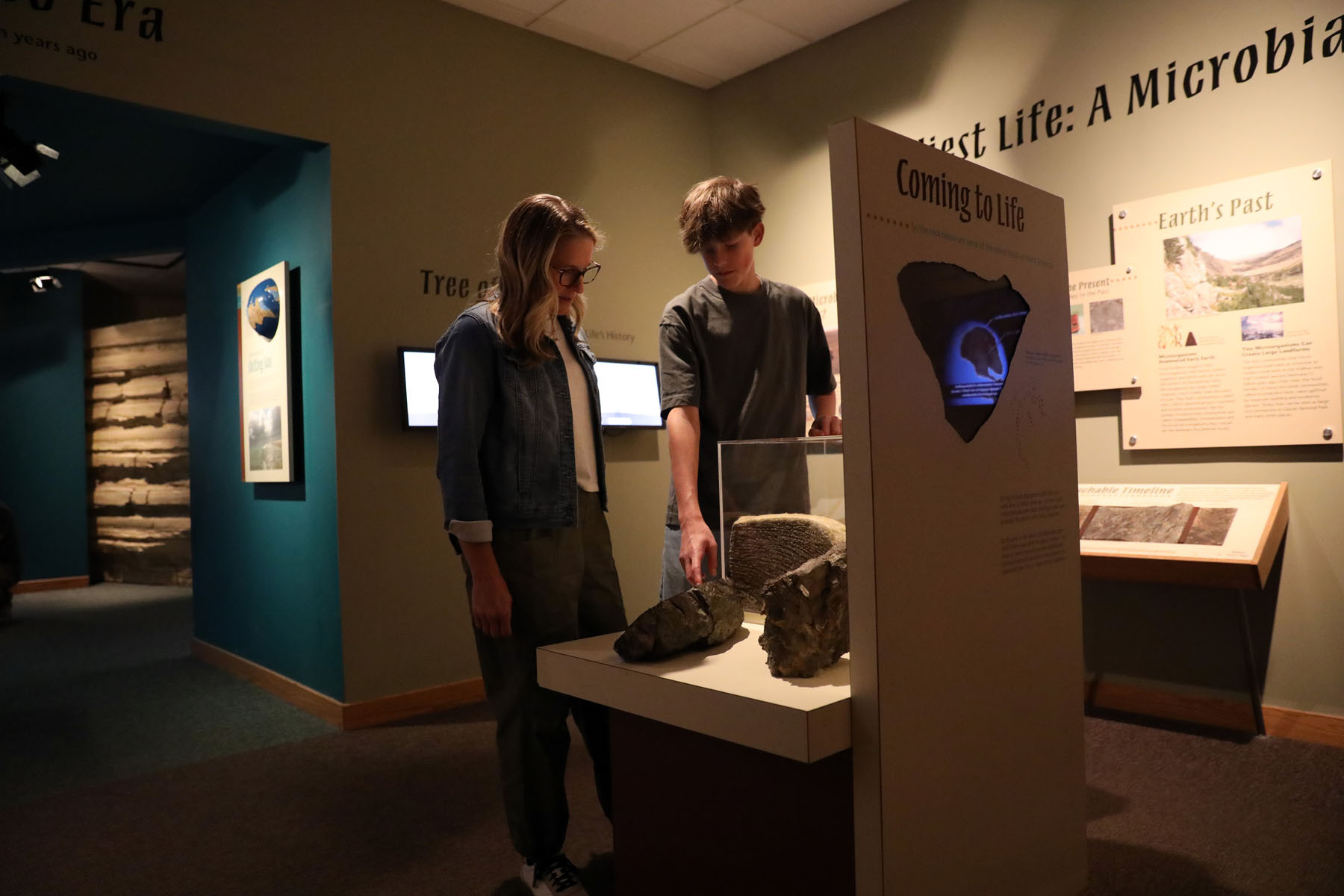
Did you know that some of the oldest rocks in North America are found in Montana? Travel through 4.6 billion years of Earth’s dynamic prehistory as you begin your journey through time in the Siebel Dinosaur Complex. Walk through the reconstruction of a 2.7 billion-year-old fissure, explore how mountains have risen and seas have spread, and encounter some of the many organisms that evolved in the northern Rocky Mountains region.

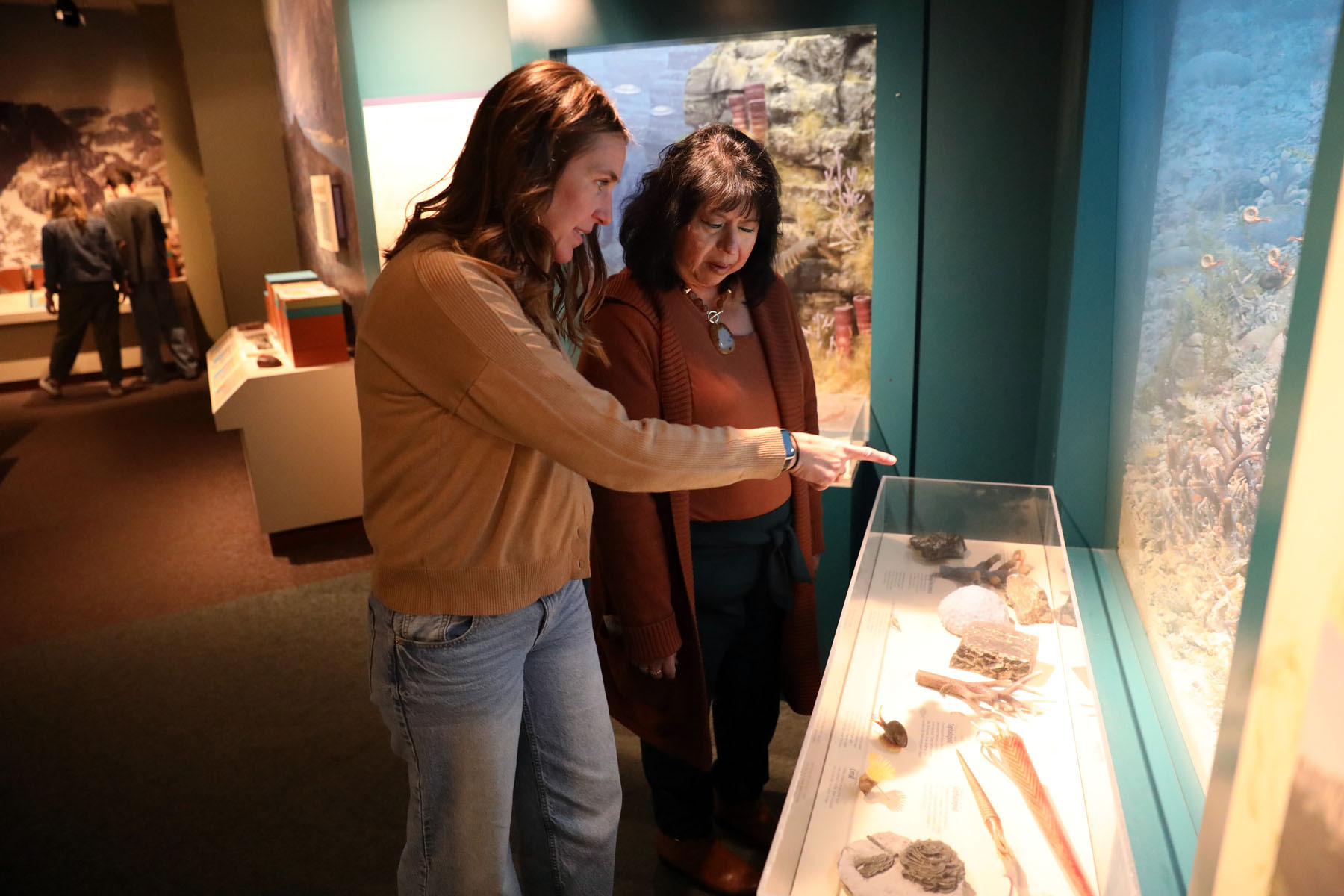
Two visitors examine a display case containing fossil specimens in the Landforms/Lifeforms gallery, with another illustrative display case showing a prehistoric ecosystem visible on the wall behind them.
Landforms/Lifeforms Visitors
Two visitors at Museum of the Rockies lean in to closely examine an illustrated geologic timeline panel within the Landforms/Lifeforms gallery.
Landforms/Lifeforms Panel
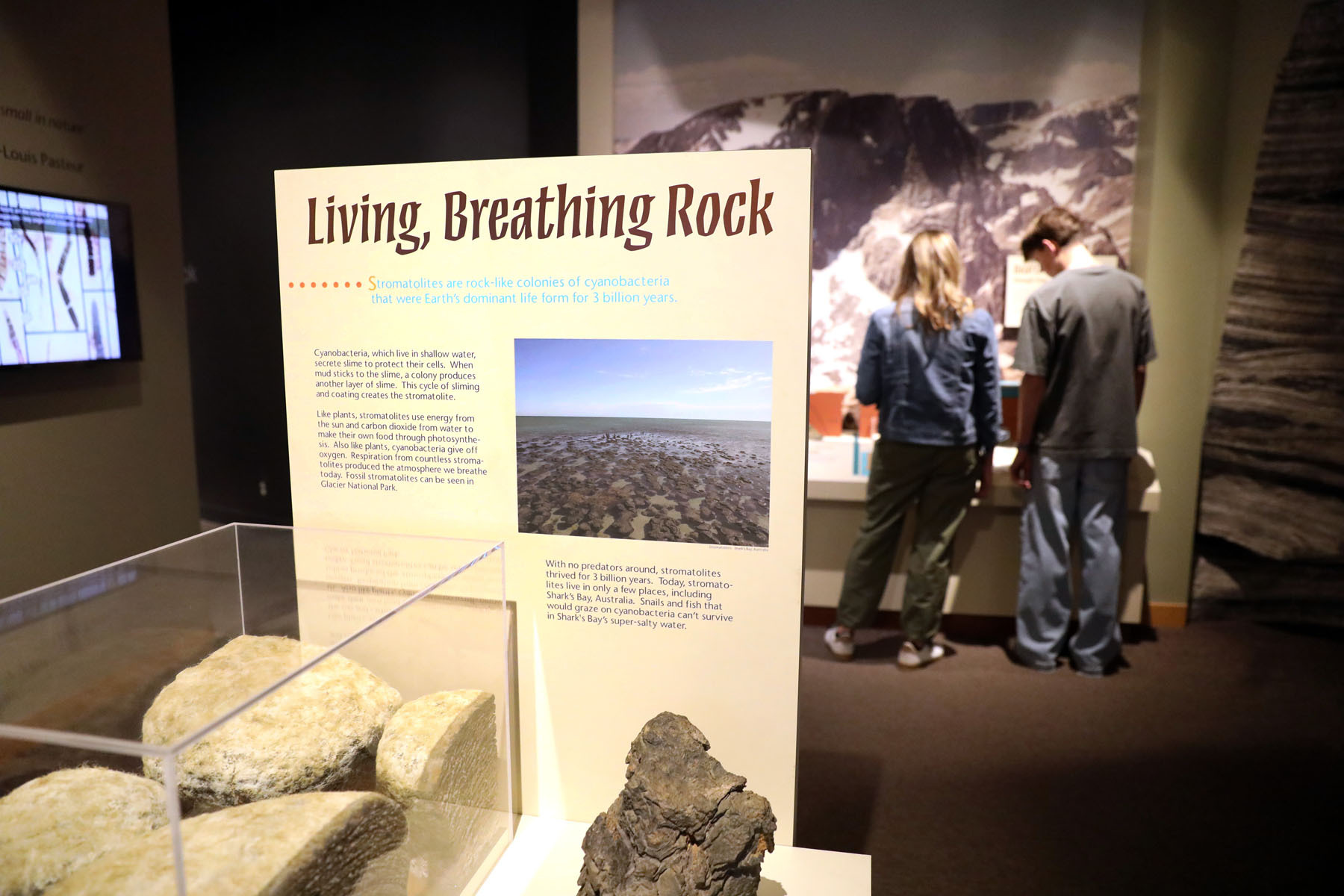
An exhibit in the Landforms/Lifeforms gallery titled "Living, Breathing Rock," featuring a display of large fossilized stromatolites behind a glass barrier while visitors observe informational panels in the background.
Landforms/Lifeforms Geology
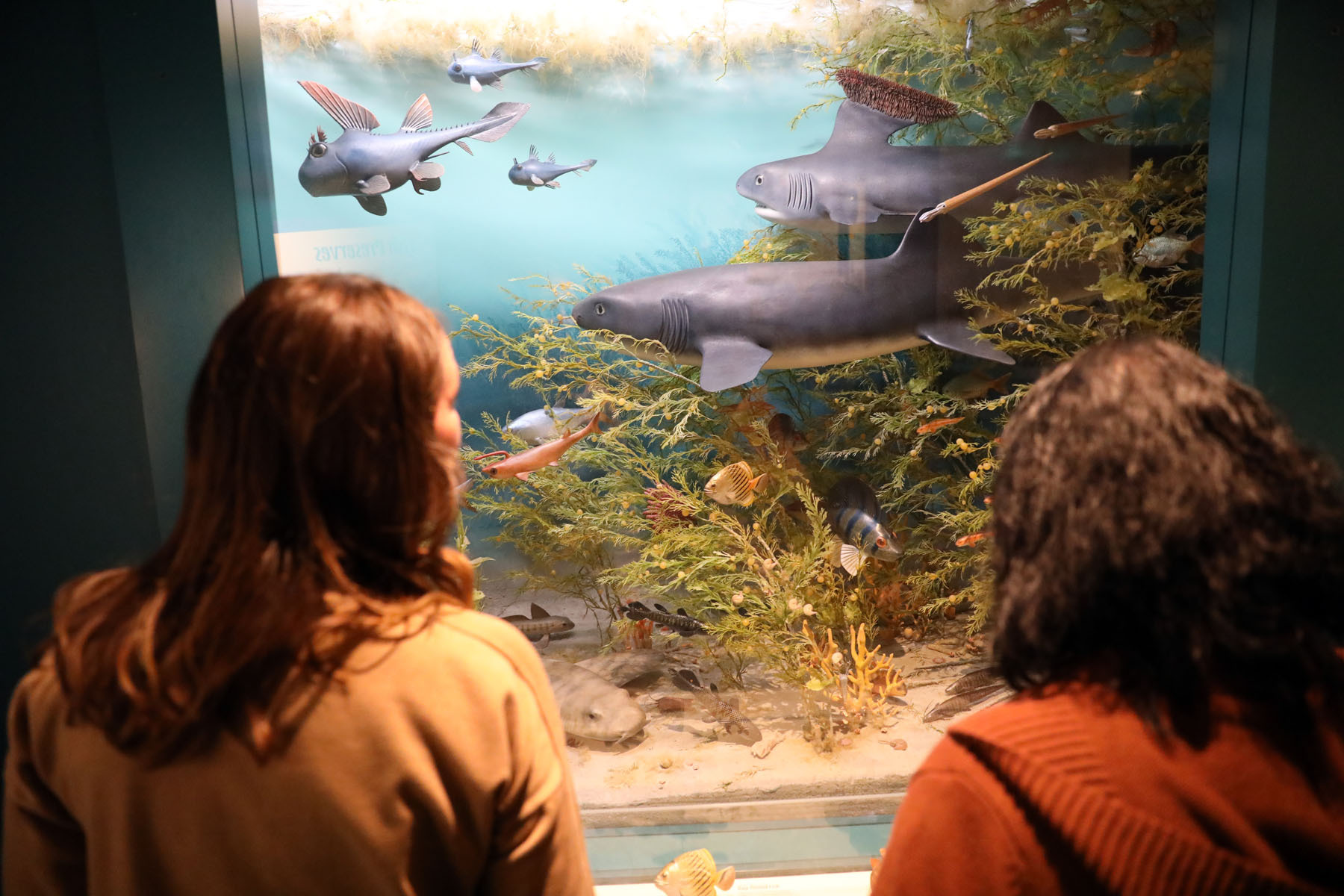
Two visitors observe a large, illuminated exhibit display featuring models of prehistoric Squalicorax suspended as if swimming, located within the Landforms/Lifeforms gallery.
Landforms/Lifeforms Prehistoric Squalicorax
Two visitors at Museum of the Rockies stand in the Landforms/Lifeforms gallery, looking at a display of prehistoric rock specimens near an informational panel titled "Earliest Life: A Microbial World."
Landforms/Lifeforms Rocks

Bowman Dinosaur Viewing Lab

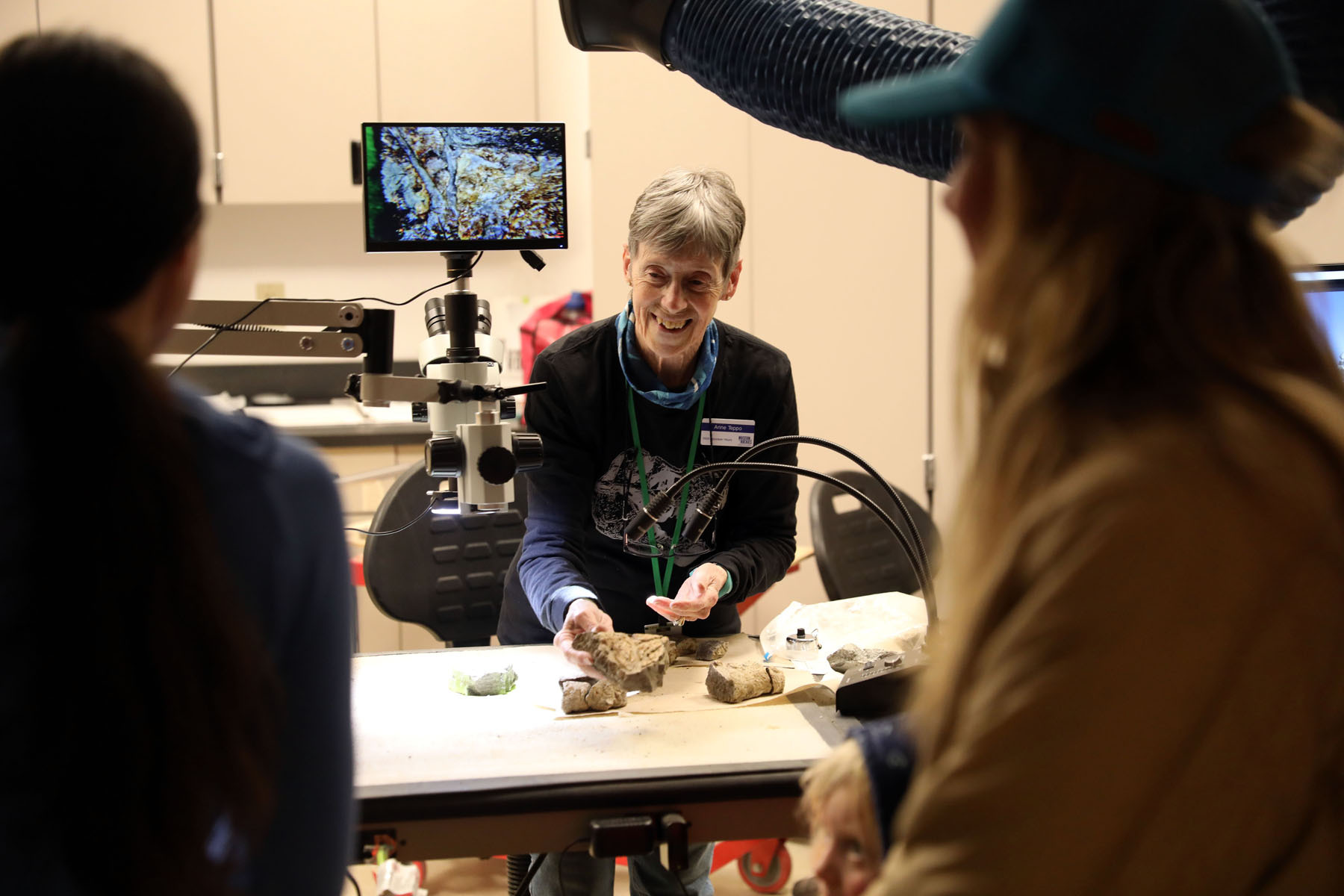
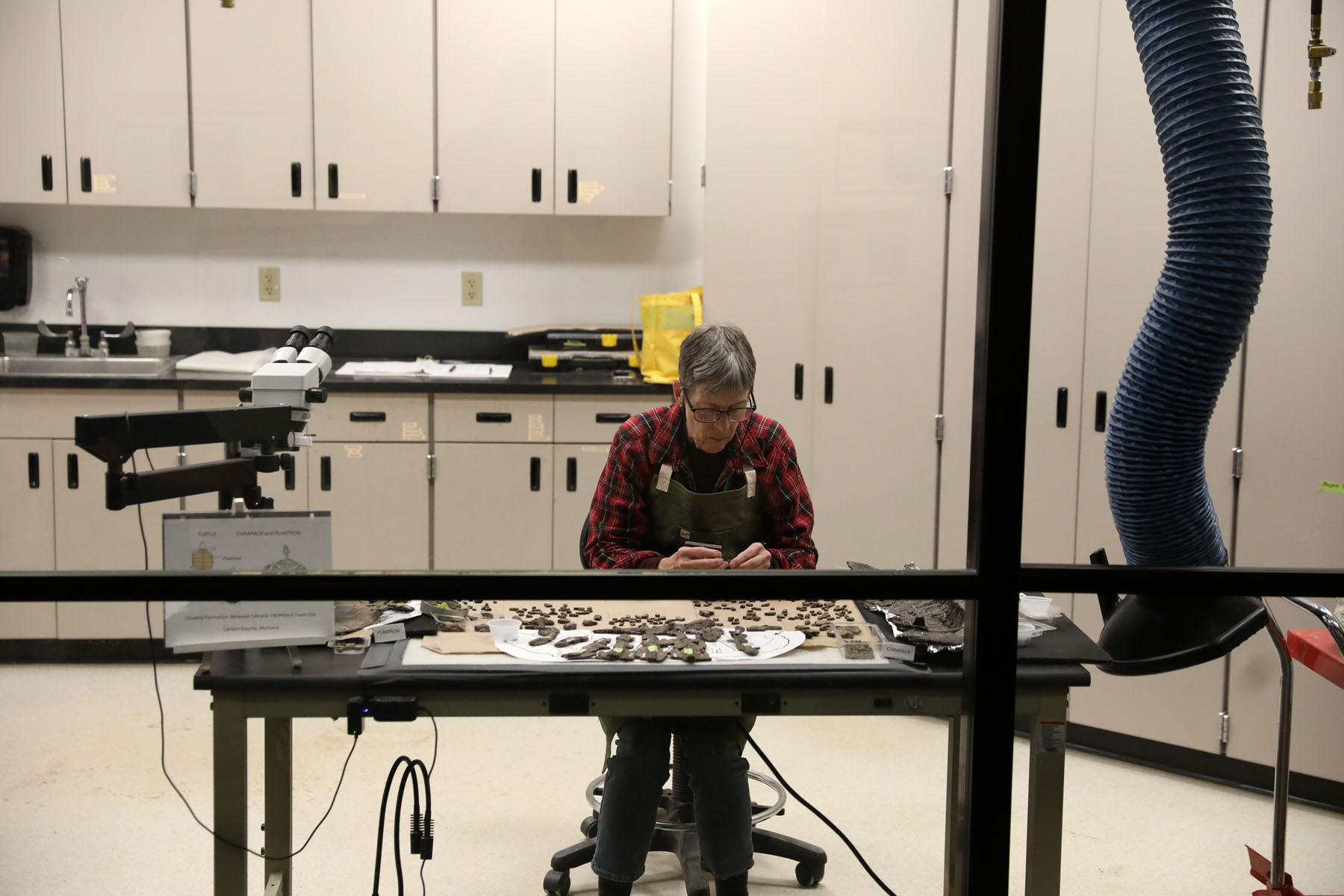
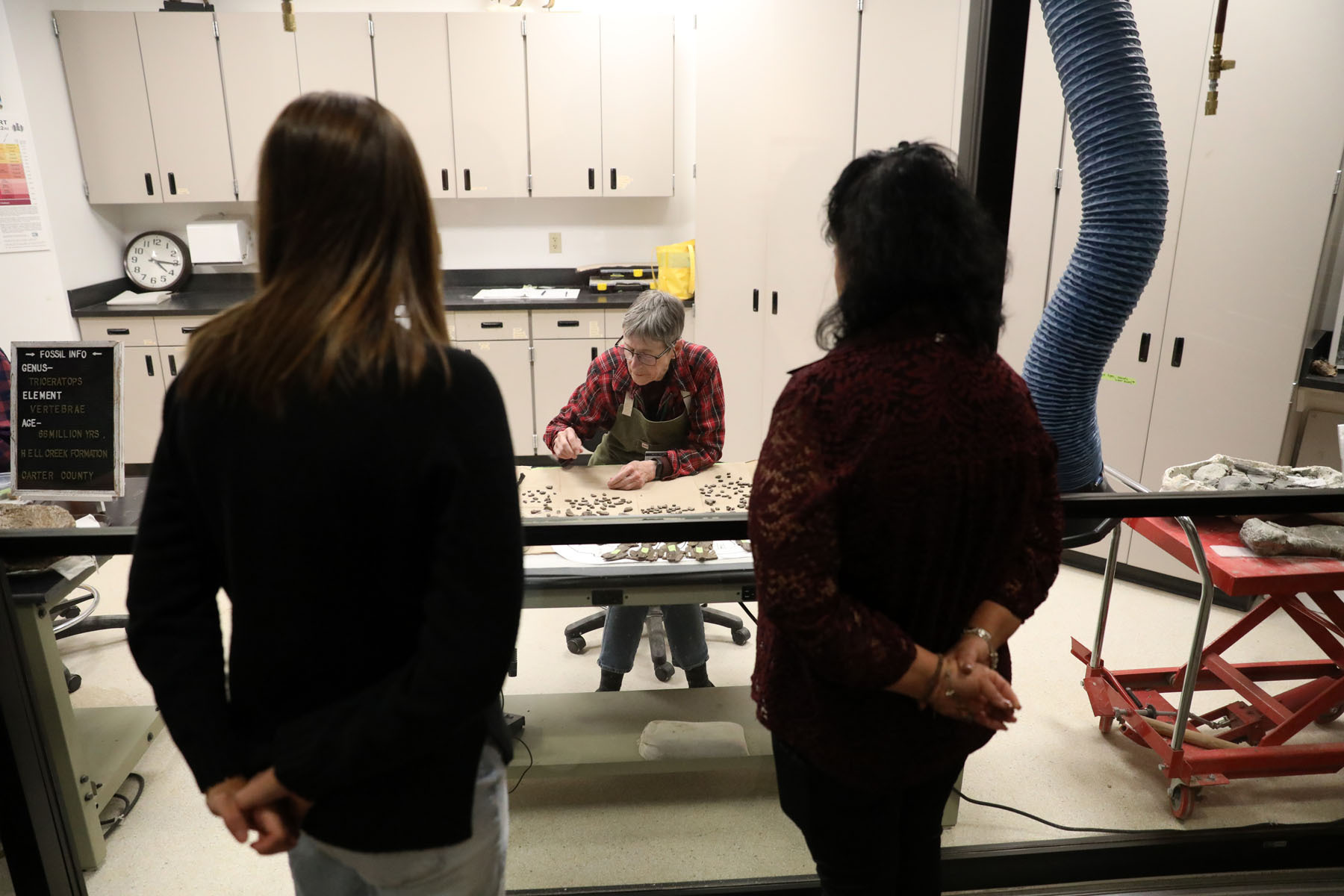
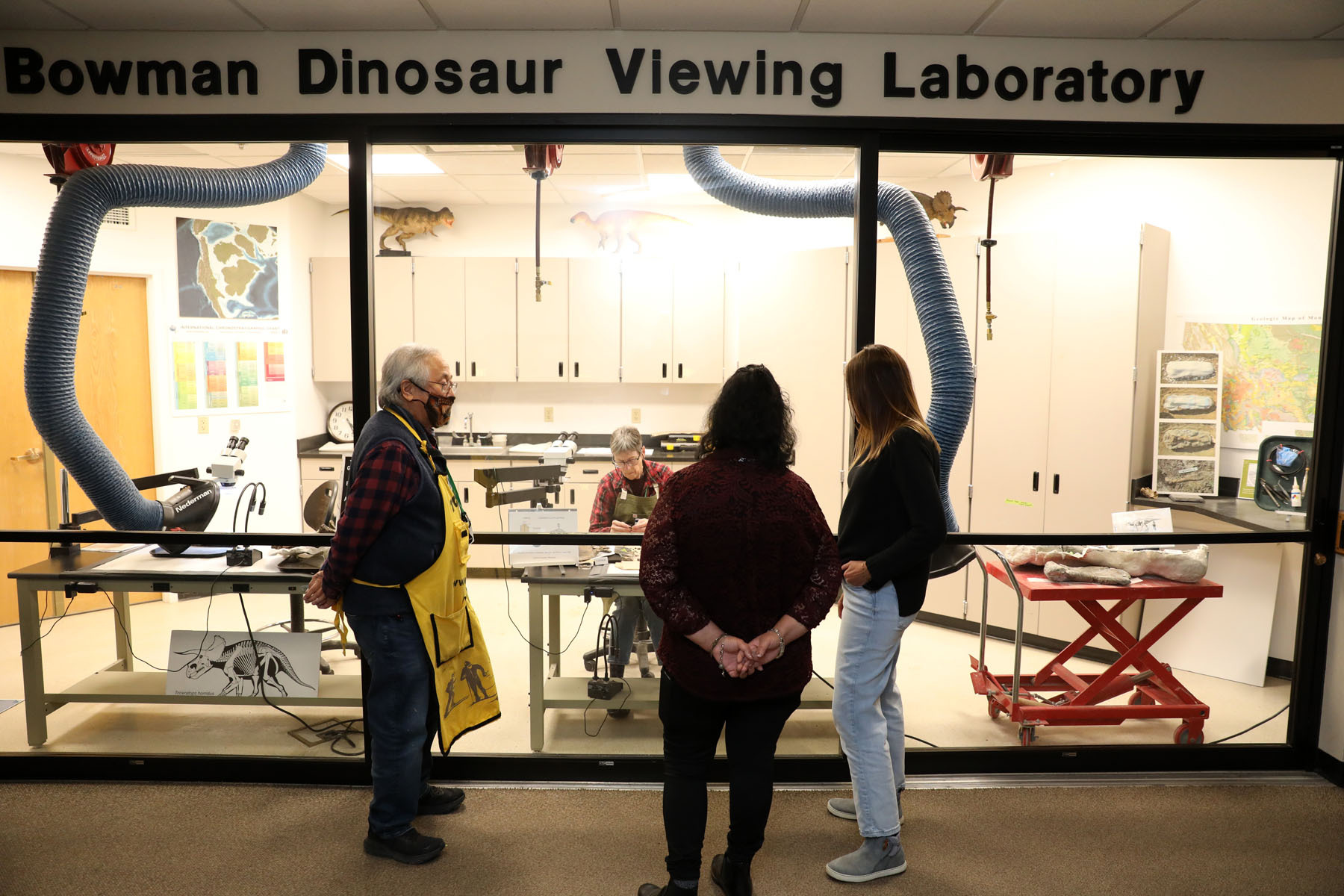
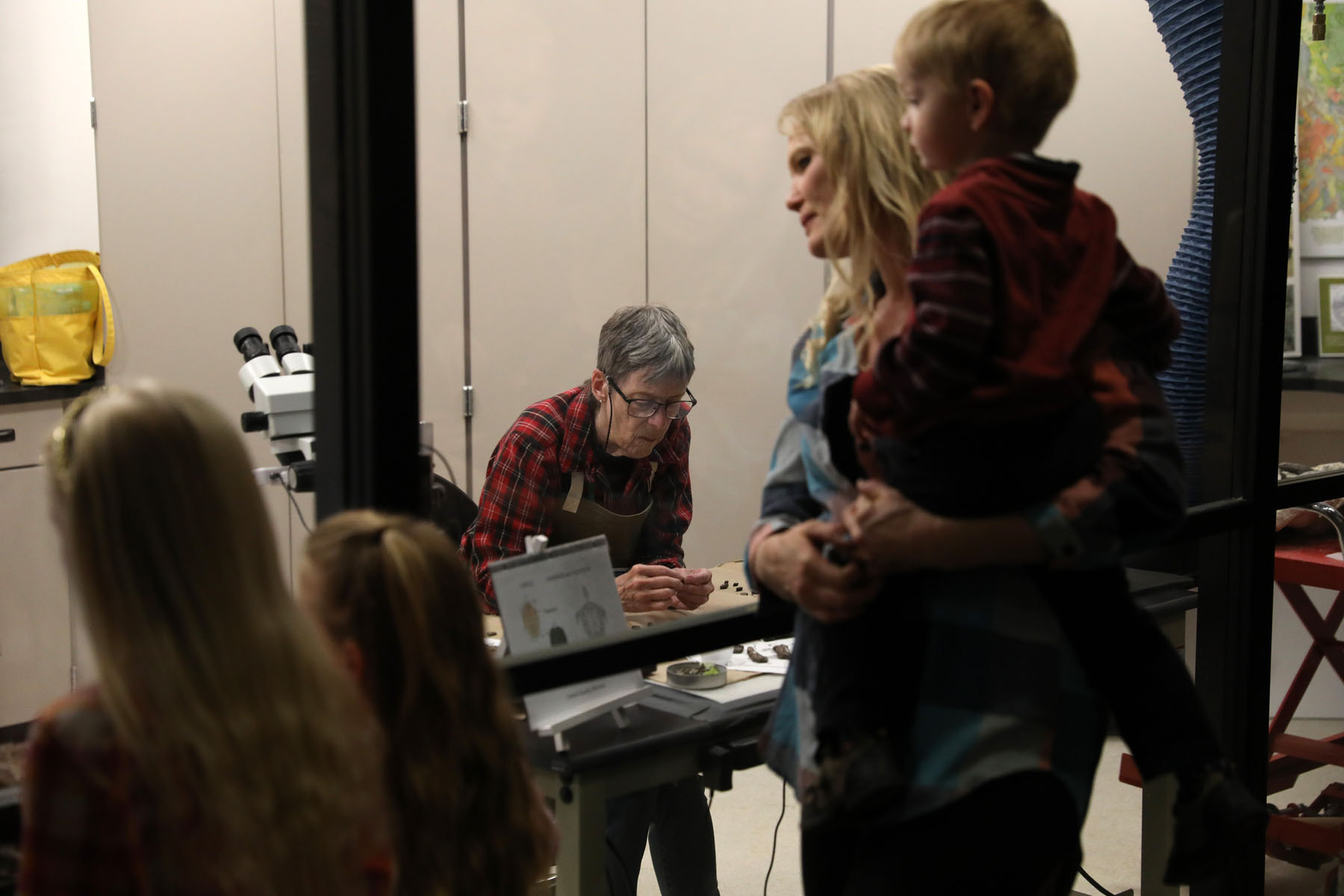
Visit the Bowman Dinosaur Viewing Lab and see the process of fossil preparation. Watch MOR volunteer preparators remove rock from around the bones of dinosaurs and other ancient creatures and carefully piece the fossils back together. Preparators are happy to answer your questions and explain how they ready these specimens for study.

The lab is active seven days a week between the hours of 10 a.m. to 4 p.m.

A volunteer works at a laboratory bench inside the Bowman Dinosaur Viewing Lab, carefully examining and sorting small fossil specimens laid out on the table.
Bowman Dinosaur Viewing Lab Volunteer
Two visitors stand in the foreground, looking through a large window into the Bowman Dinosaur Viewing Lab, where a staff member is visible working on a fossil on a laboratory table.
Bowman Dinosaur Viewing Lab
A paleontology volunteer stands outside the glass observation window of the Bowman Dinosaur Viewing Laboratory to answer questions for two visitors, while another volunteer continues working at a laboratory bench inside the facility.
Bowman Dinosaur Viewing Lab Wisdom
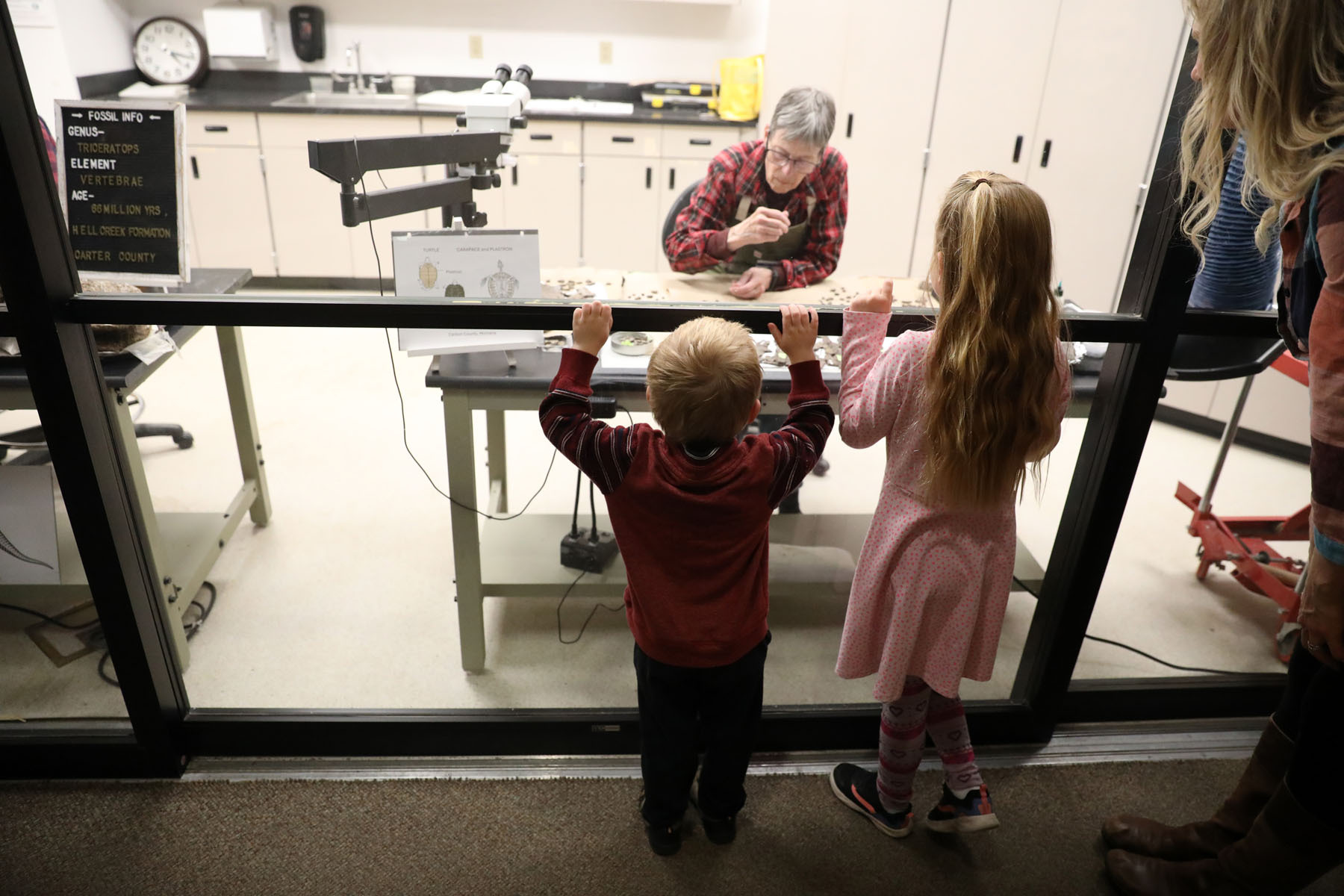
Two young children peer through a large observation window into the Bowman Dinosaur Viewing Lab, watching a technician carefully work on fossils on a laboratory table.
Bowman Dinosaur Viewing Lab + Children
A family, including a young child, stands outside the glass observation window of the Bowman Dinosaur Viewing Lab, watching a technician work with small fossil fragments and specialized equipment.
Bowman Dinosaur Viewing Lab + Family

Hall of Giants & Mesozoic Overlook

Hall of Giants

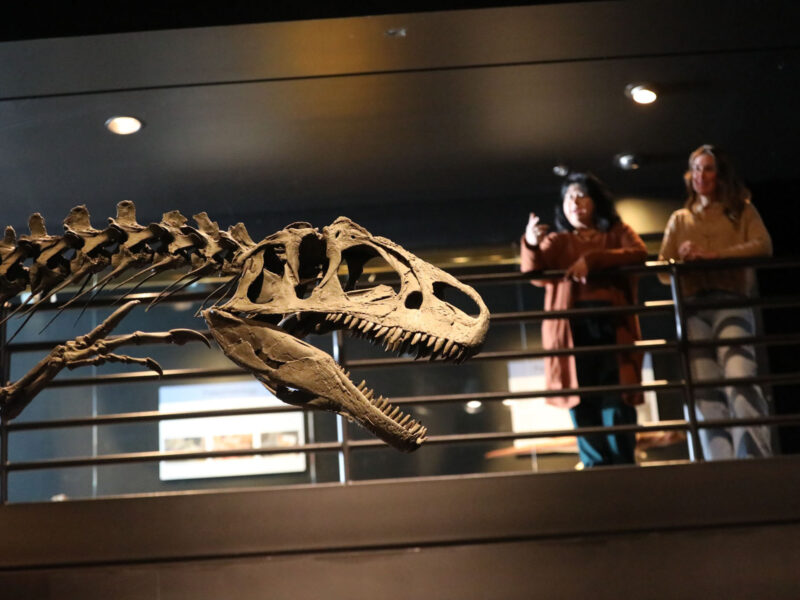
Begin your journey through the Age of Dinosaurs in the Hall of Giants. Enter the Jurassic Period and encounter "Big Al", one of the most complete Allosaurus ever discovered. This Jurassic carnivore’s skeleton records evidence of a hard life, including injuries and infections.

As you enter the Cretaceous Period, you will meet Deinonychus. The discovery of this relative of Velociraptor helped cement the link between ancient dinosaurs and modern birds.

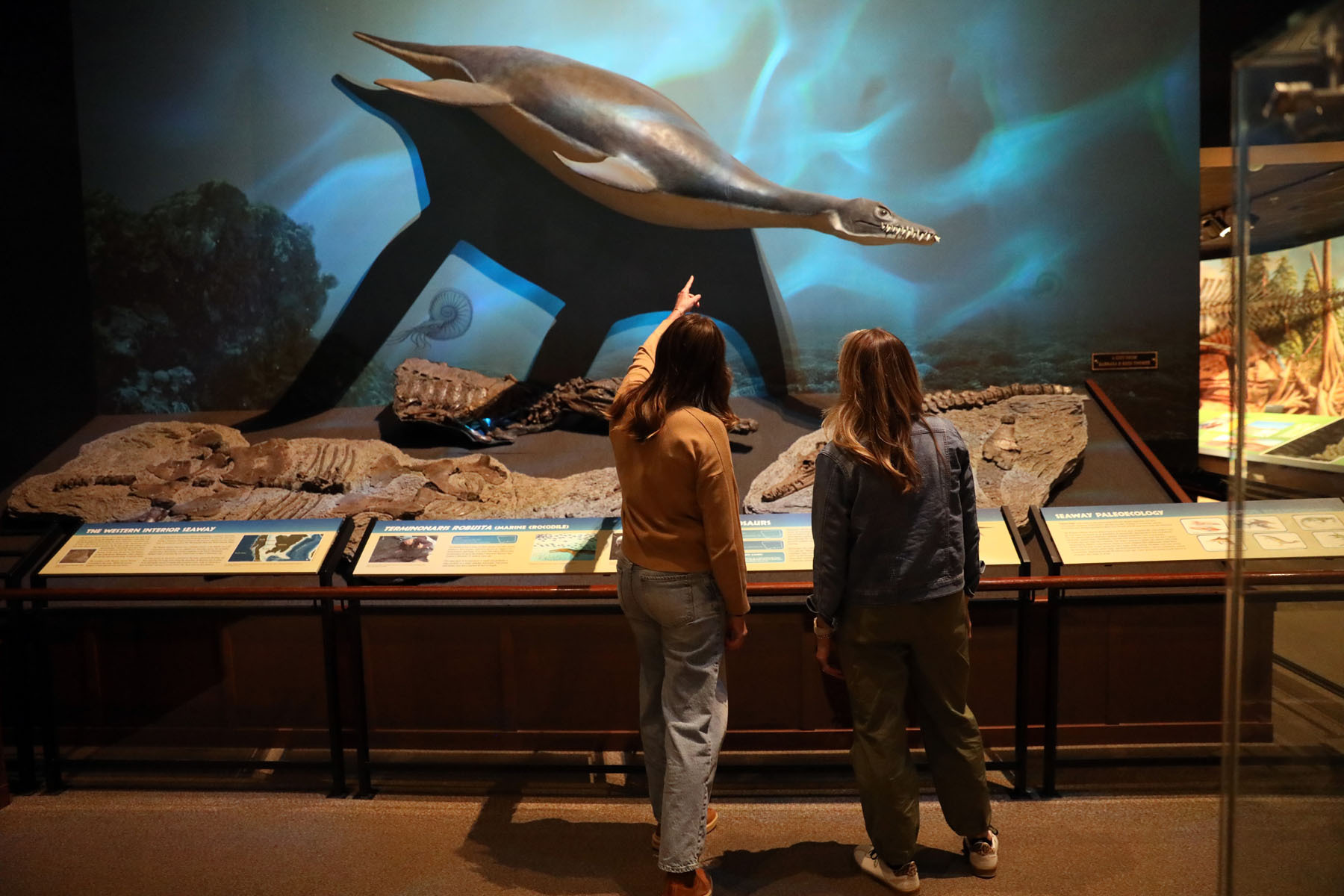
As the tides change, dip under the surface of the seaway that covered much of North America during the Cretaceous, and keep an eye out for carnivorous marine reptiles.

Then, peek inside the lair of Oryctodromeus, the first dinosaur discovered inside a burrow.

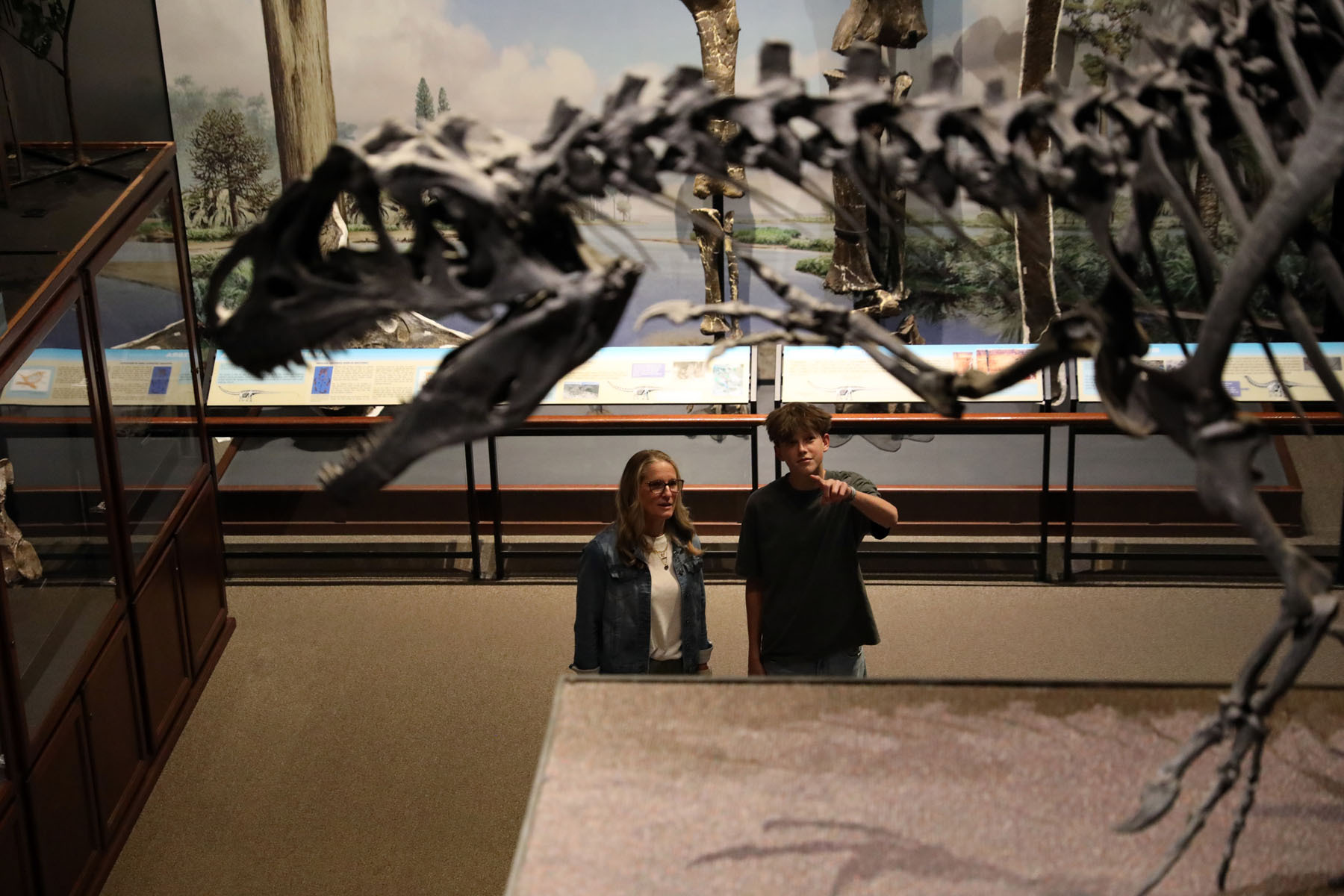
A side-profile view of the "Big Al" Allosaurus skeleton's head and neck on display, with two museum visitors observing the exhibit from the Mesozoic Overlook balcony in the background.

“This is a beautiful museum that features a lot of dinosaurs, dinosaur interactions and information. If you like BIG dinosaur skeletons, this is your place.”

- L (Google Review)

Mesozoic Overlook

How do fossils get to a museum? Explore the process of paleontology, from the small fragments of bone that first reveal that a dinosaur skeleton is nearby, through the collection, preparation, curation, and study of the creatures found in the Siebel Dinosaur Complex. This vantage point provides an overview of the skeleton of "Big Al" and the other inhabitants of the Hall of Giants

A staircase located adjacent to the Bowman Dinosaur Viewing Lab will lead you up to the Overlook. Alternate access to the Overlook can be achieved via elevator by inquiring at the Front Desk.

Two visitors observe a life-sized reconstruction of an Edgarosaurus, a prehistoric marine reptile, which is mounted above a display case of fossil specimens in the Hall of Giants.
Hall of Giants Marine Reptile Edgarosaurus Reconstruction
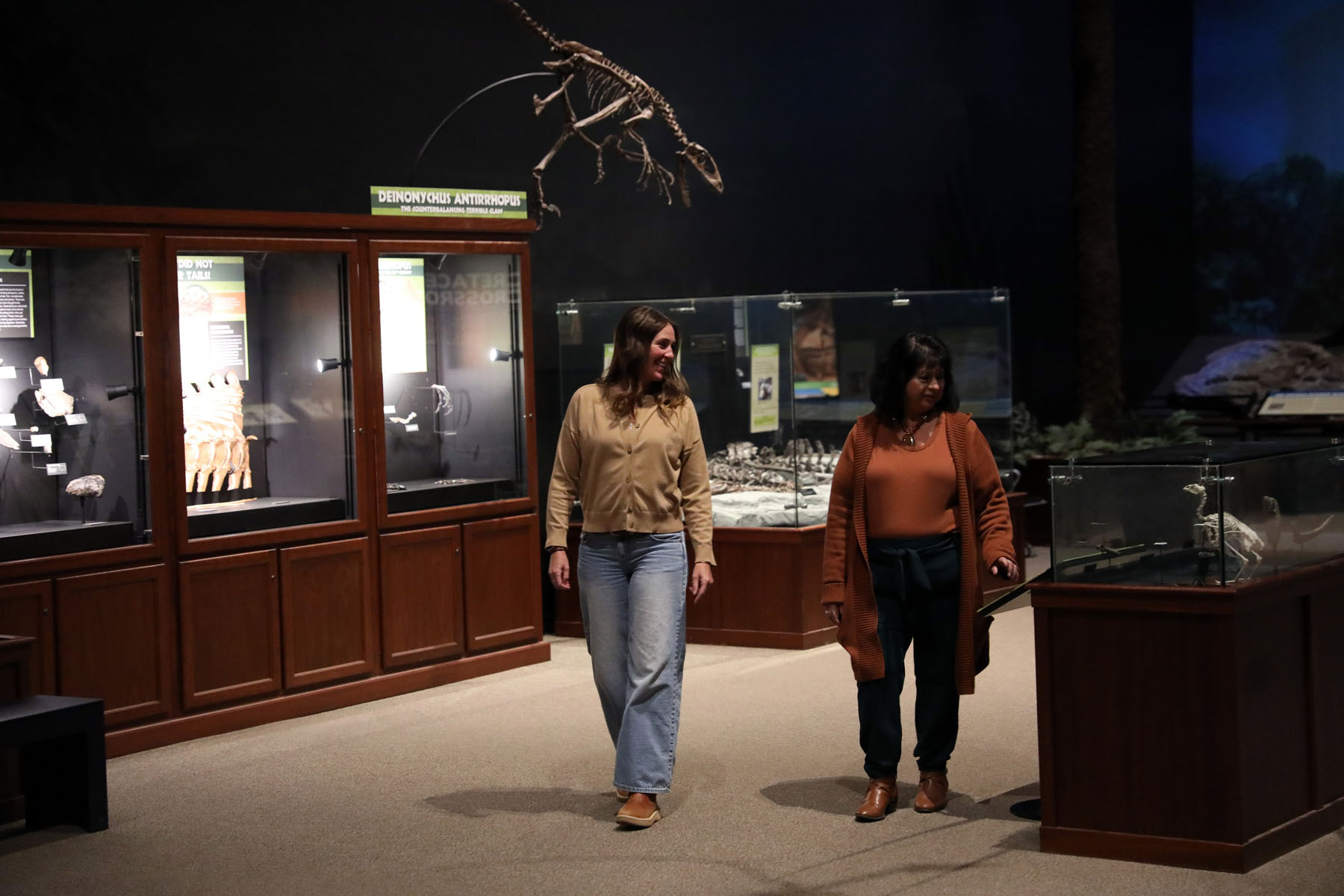
Two visitors walk past large wooden display cases and informational panels in the Hall of Giants gallery at Museum of the Rockies.
Hall of Giants Visitors
An elevated, wide-angle view of the Hall of Giants gallery, showing visitors walking among various fossil displays and glass exhibit cases arranged across the museum floor.
Hall of Giants Overview
A close-up view of the "Big Al" Allosaurus skeleton in the Hall of Giants, showing the dinosaur's skull and ribcage as two museum visitors observe the display from the floor below.
Hall of Giants Big Al
An exhibit in the Hall of Giants featuring the "Big Al" Allosaurus skeleton alongside a bone growth display, with an illustrative mural of a prehistoric landscape in the background of the gallery.
Hall of Giants Big Al + Bone Growth Display

Cretaceous Crossroads

On Earth, it is generally true that where there is water, there is life. This was certainly the case with the Western Interior Sea during the Late Cretaceous. This large seaway, which bisected North America, was not only teeming with marine life; it also cultivated a rich habitat for plants and animals along its shores. As mosasaurs and other aquatic reptiles hunted beneath the waves, tyrannosaurs ascended to the top of the food chain on land, where they remained until the end of the Cretaceous, when the age of the dinosaurs drew to a close.

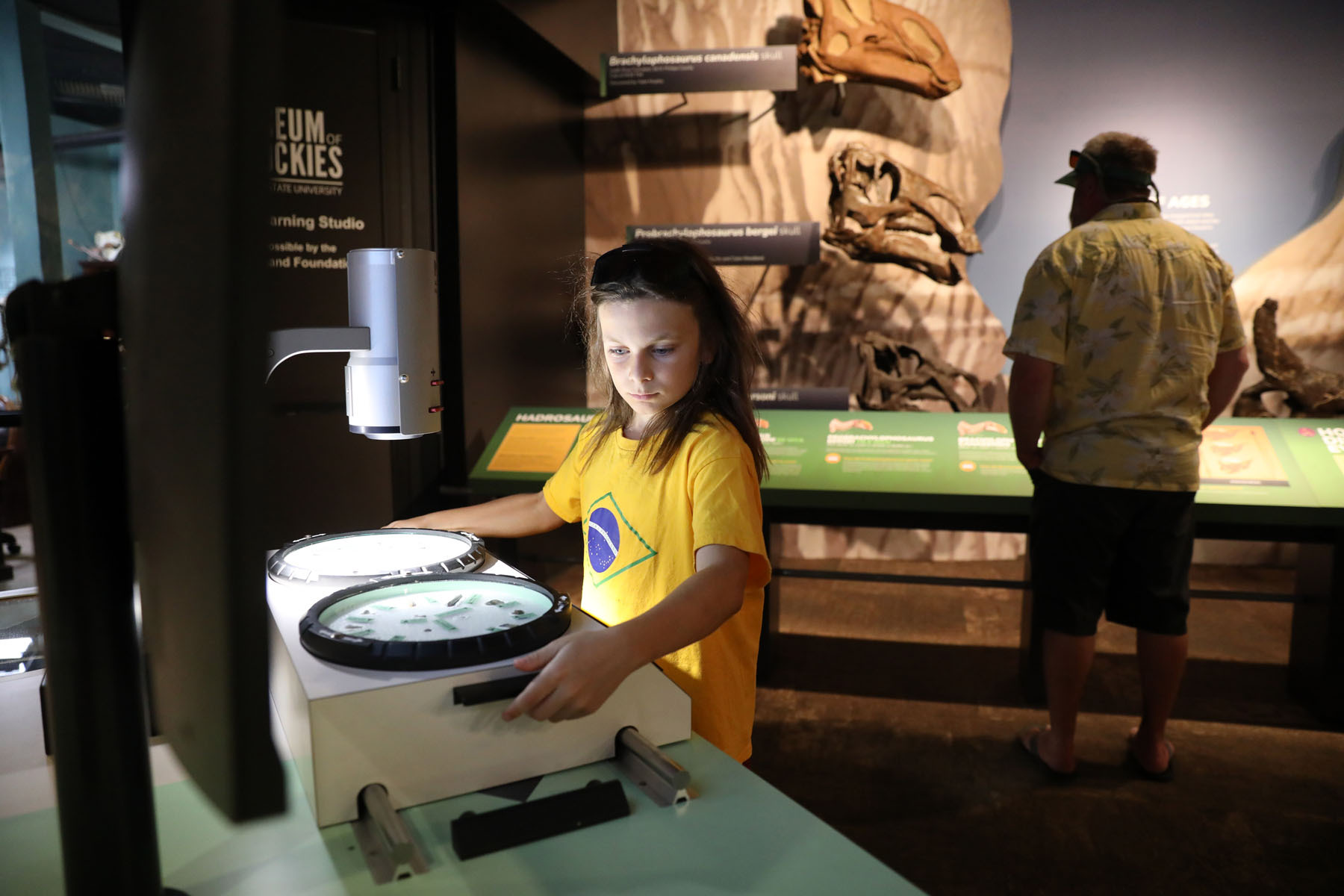
For the first time in over ten years, Museum of the Rockies unveiled this new primary paleontology exhibition on July 2, 2025. Cretaceous Crossroads explores this time of transition, with a focus on three geologic formations in Montana (Two Medicine, Judith River, and Bearpaw) that span the period from 72 to 82 million years ago. The exhibit is comprised of real fossil material, 3D prints, casting, reproductions, murals, new paleo-art, AV interactives, an augmented reality piece, microscope stations, discovery drawers, and more.

Visitors will see a mounted Maiasaura (Montana’s State Fossil) tending to its nest, a 30-foot-long

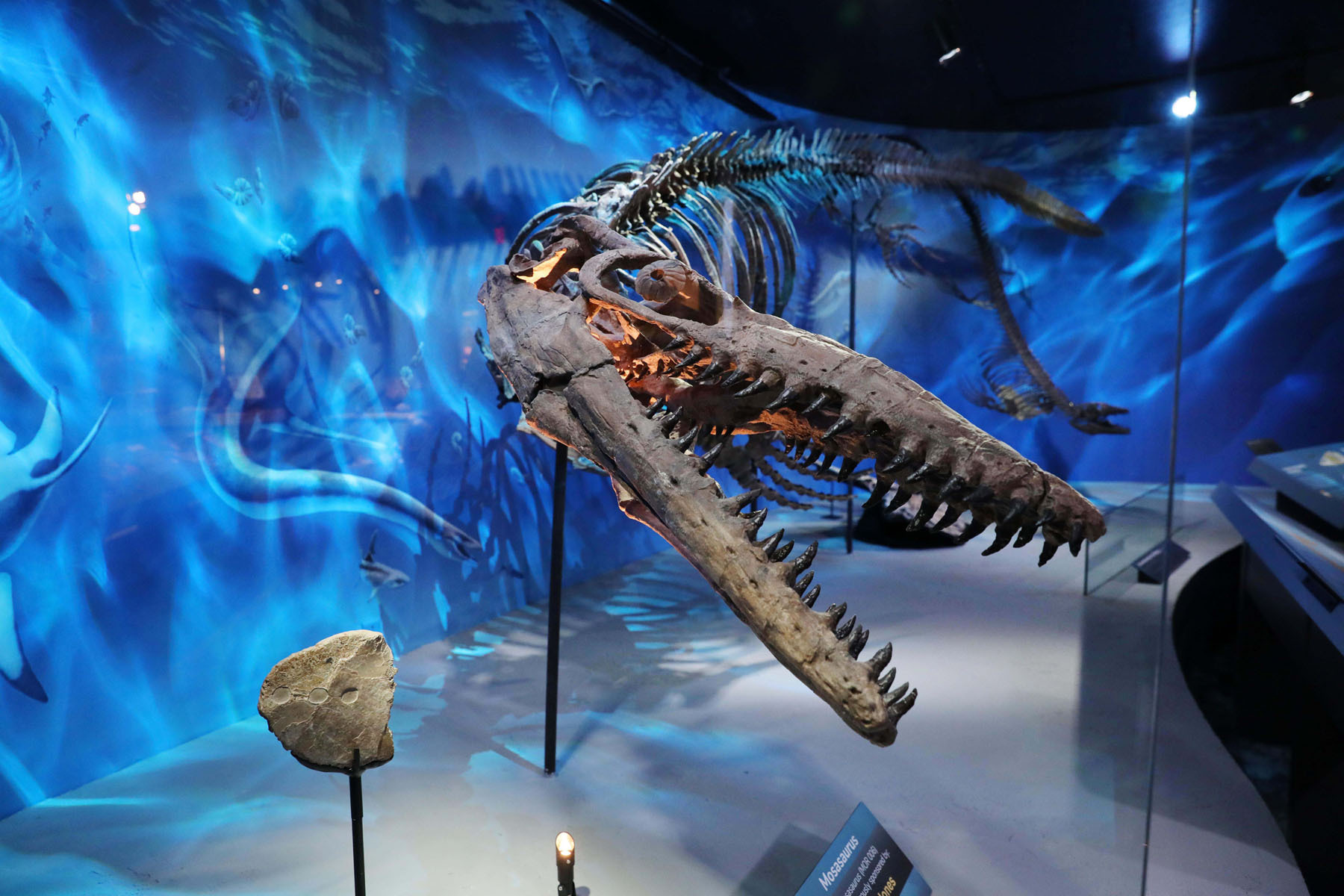
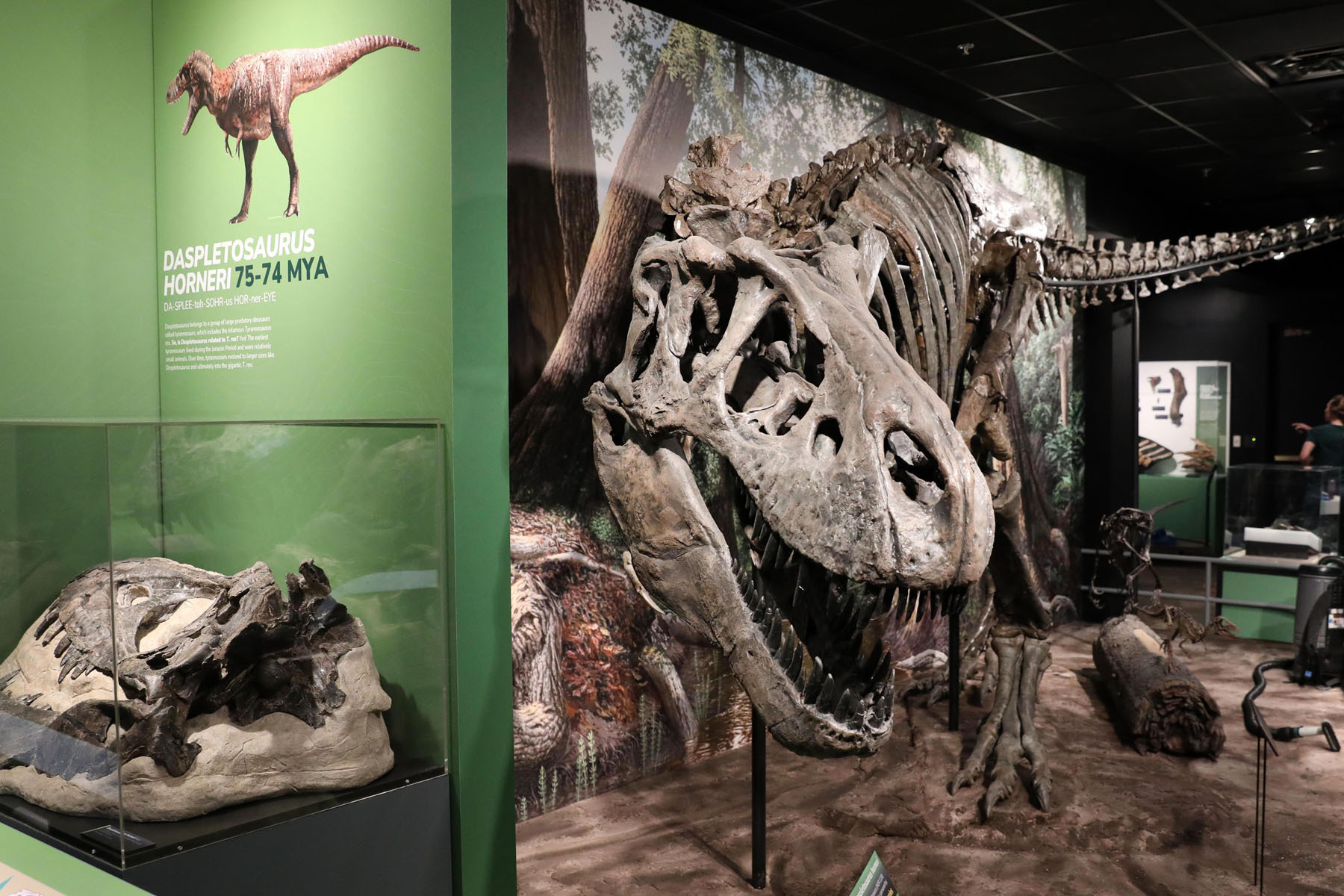
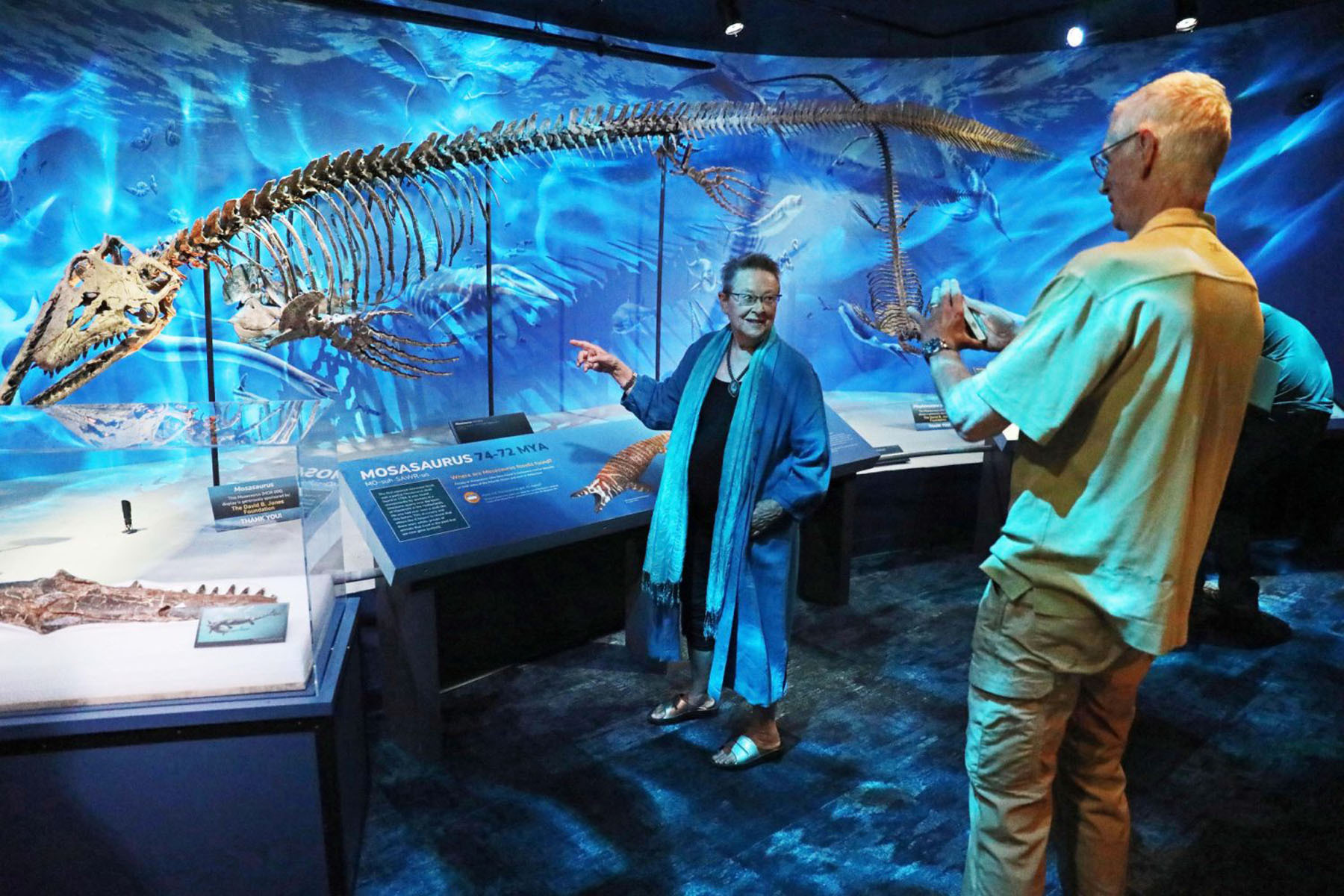
Daspletosaurus horneri (large meat-eating dinosaur, cousin to T. rex, dinosaur eggs and clutches, Troodon (small raptor-like dinosaurs), a 23-foot-long Mosasaurus, and many other specimens, some of which are only known from Montana. This includes never-before-seen specimens that are not just new to Museum of the Rockies; they are new to science!

A fossilized mosasaur skull with sharp, prominent teeth is displayed in the Cretaceous Crossroads exhibit against a dramatic blue background that evokes an underwater environment.
Cretaceous Crossroads Mosasaur
An exhibit display in the Cretaceous Crossroads gallery featuring replica skeletal fossils of the Daspletosaurus horneri, with an illustrative banner in the background showing a riparian woodland scene.
Cretaceous Crossroads Daspletosaurus horneri
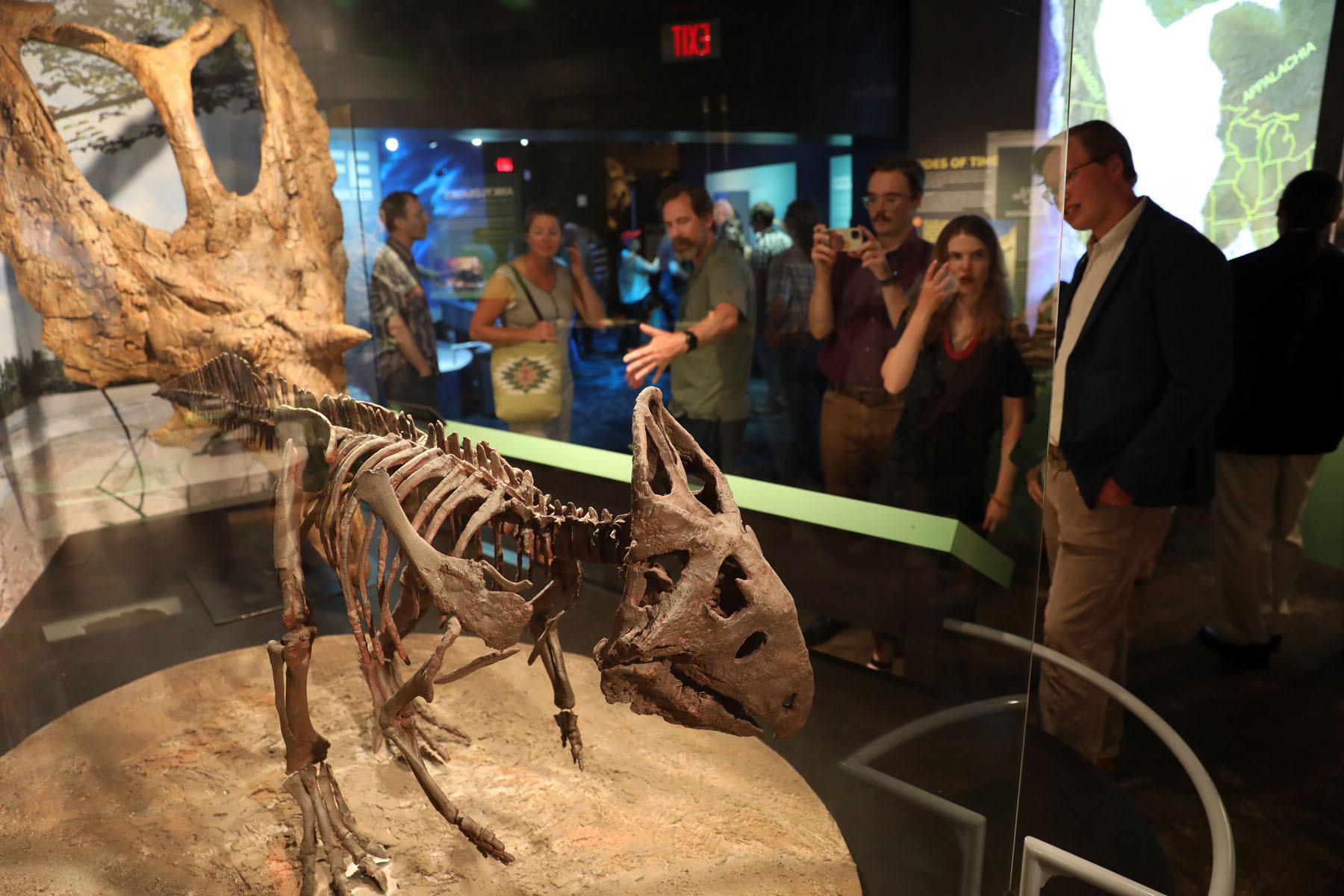
A detailed view of a Cerasinops skeleton on display in the Cretaceous Crossroads exhibit, with museum visitors observing the unnamed horned-dinosaur skull in the background of the gallery.
Cretaceous Crossroads Cerasinops
A young visitor uses an interactive microscope station in the Cretaceous Crossroads exhibit, while numerous fossilized dinosaur skulls are visible in the background.
Cretaceous Crossroads Microscope
Two visitors stand in front of the Mosasaur exhibit in the Cretaceous Crossroads gallery, looking at the long aquatic reptile skeleton mounted against a blue-lit wall.
Cretaceous Crossroads Mosasaur + Visitor

Hall of Horns & Teeth

Enter the world of the Hell Creek Formation and meet some of the last non-avian dinosaurs to roam Montana, including Triceratops and Tyrannosaurus rex!

Tyrant Kings 

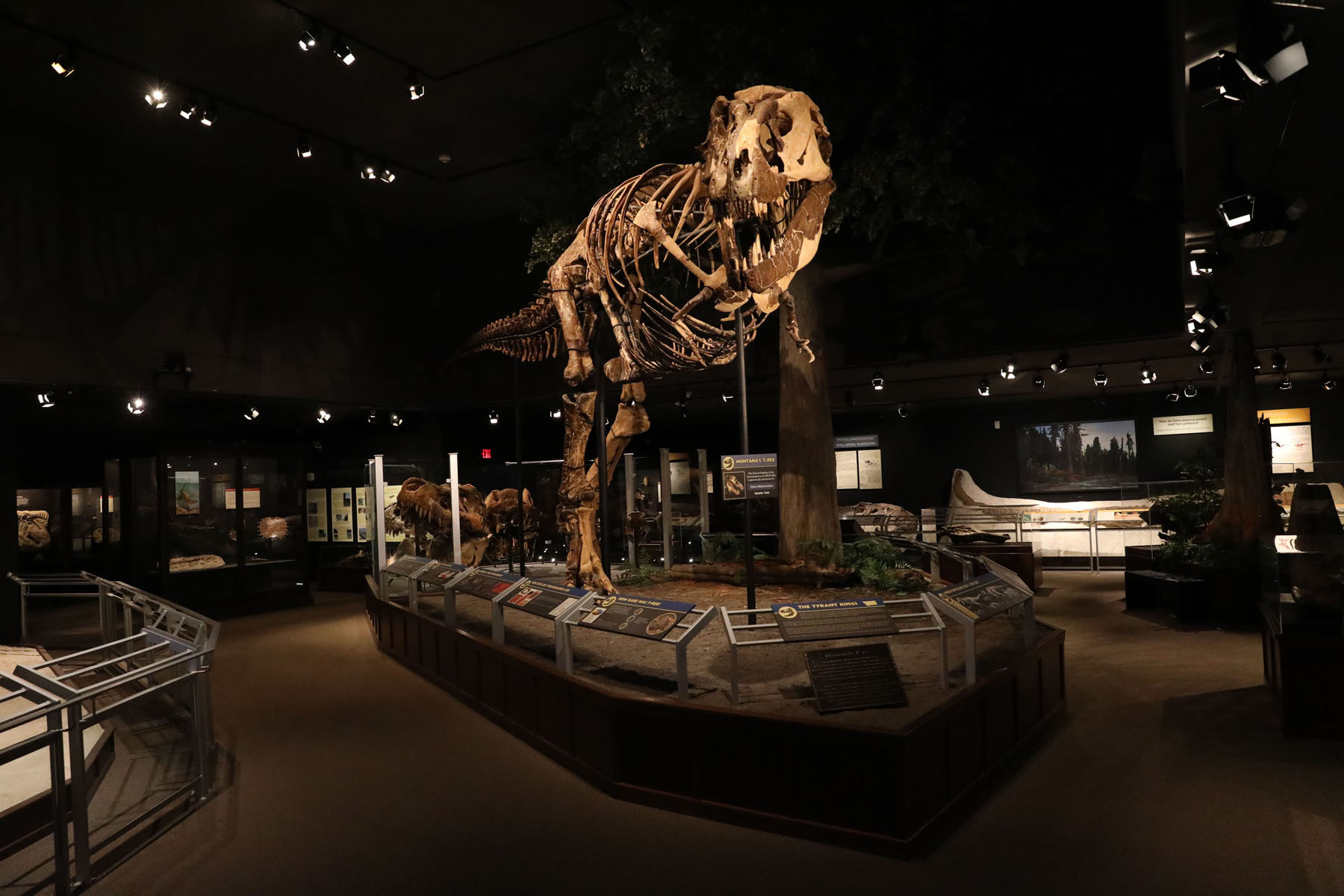
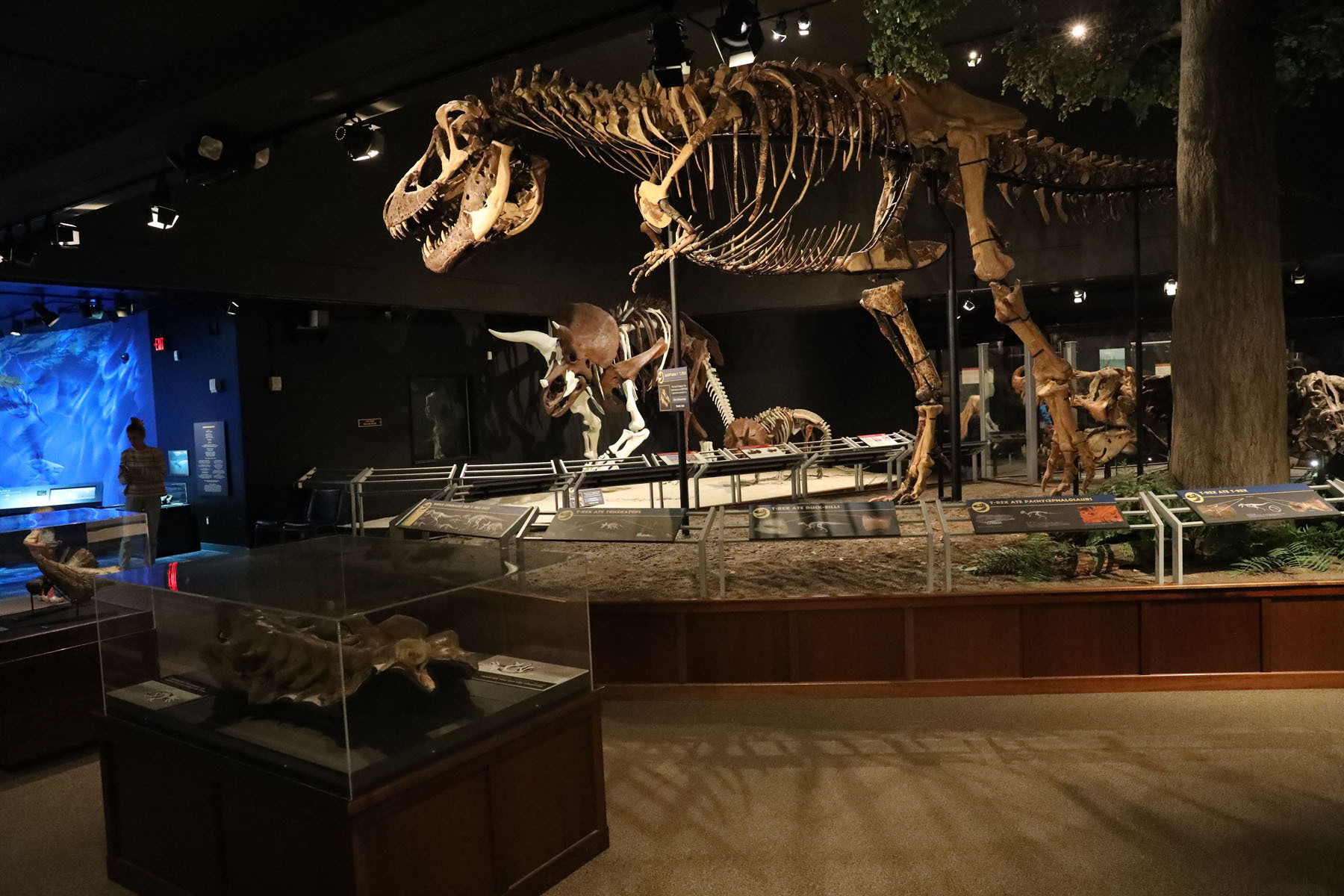
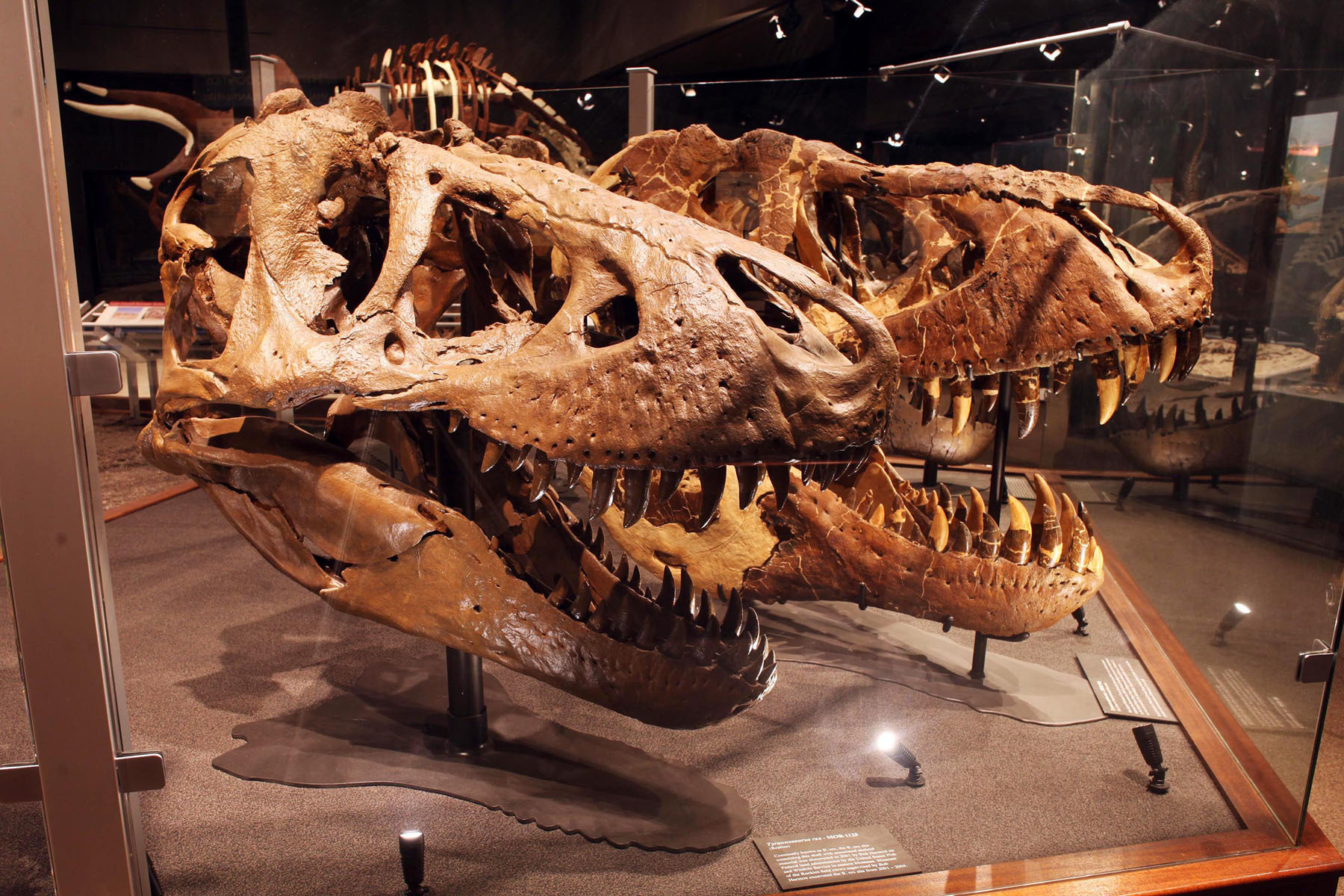
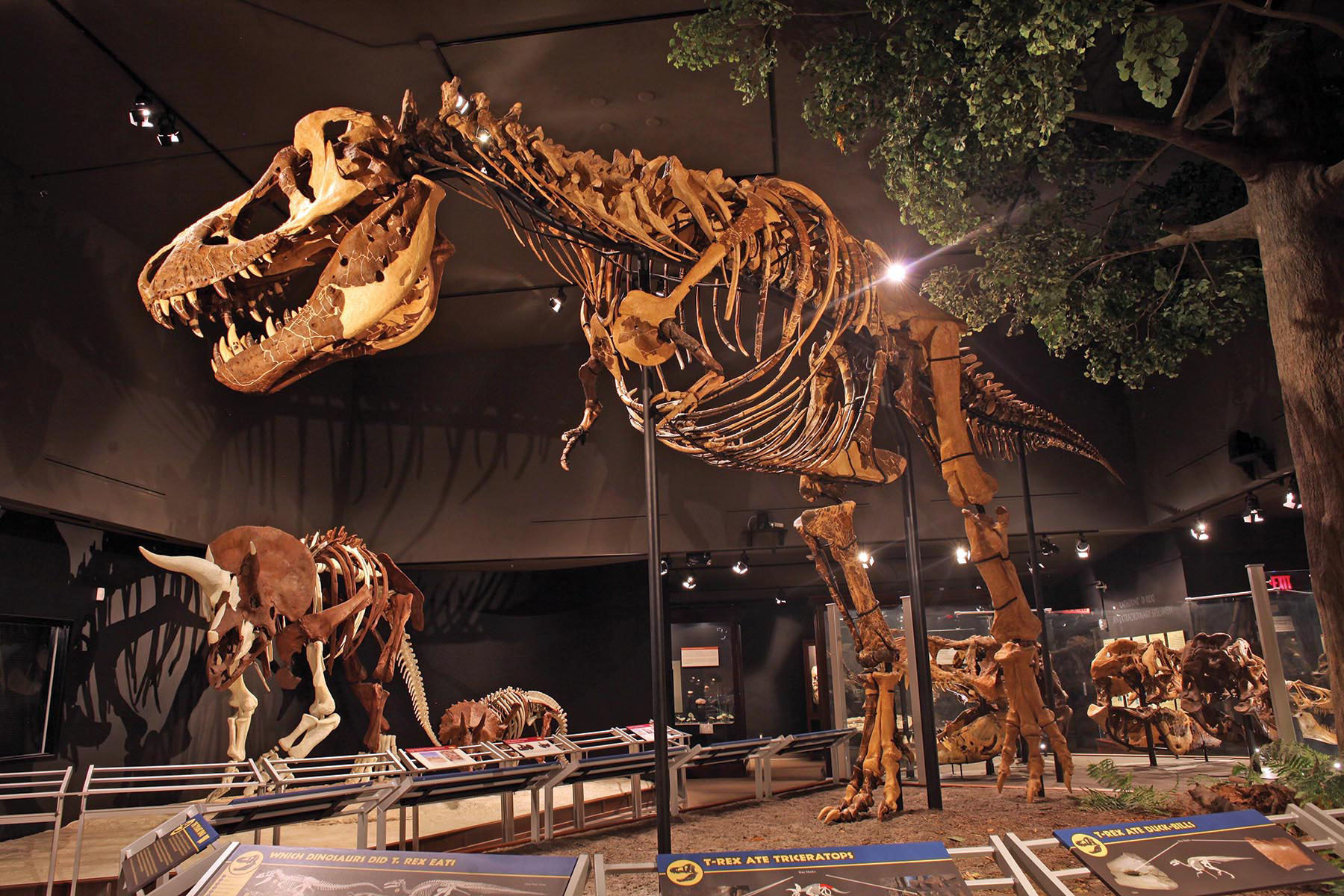
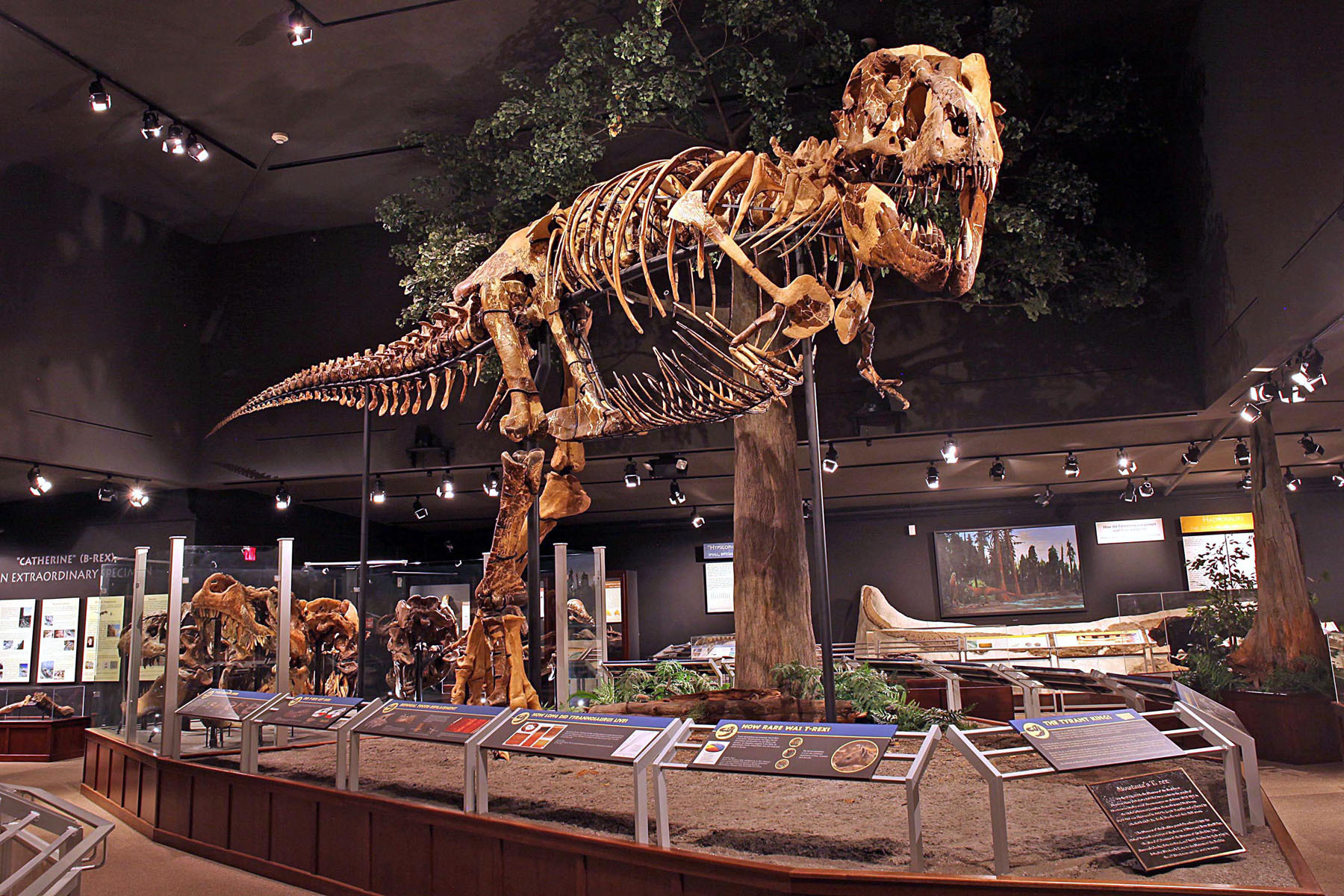
Come face to face with a world-class T. rex fossil collection including the largest and smallest skulls ever discovered! Explore what this famous dinosaur ate and how it lived. Tyrannosaurus rex, meaning “tyrant lizard king,” roamed the earth 65 million years ago. Now among only a handful of museums in the world to display a fossilized T. rex skeleton, this exhibit presents one of the most spectacular specimens ever unearthed called Montana’s T. rex. Discovered near the Fort Peck Dam and one of the most complete T. rex skeletons ever found, Montana’s T. rex stands 12 feet tall and approximately 40 feet from nose to tail. It would have weighed almost seven tons as it walked the eastern regions of the state. The Tyrant Kings, featuring Montana’s T. rex presents the science and research of Tyrannosaurus rex in a very, very big way.

Triceratops

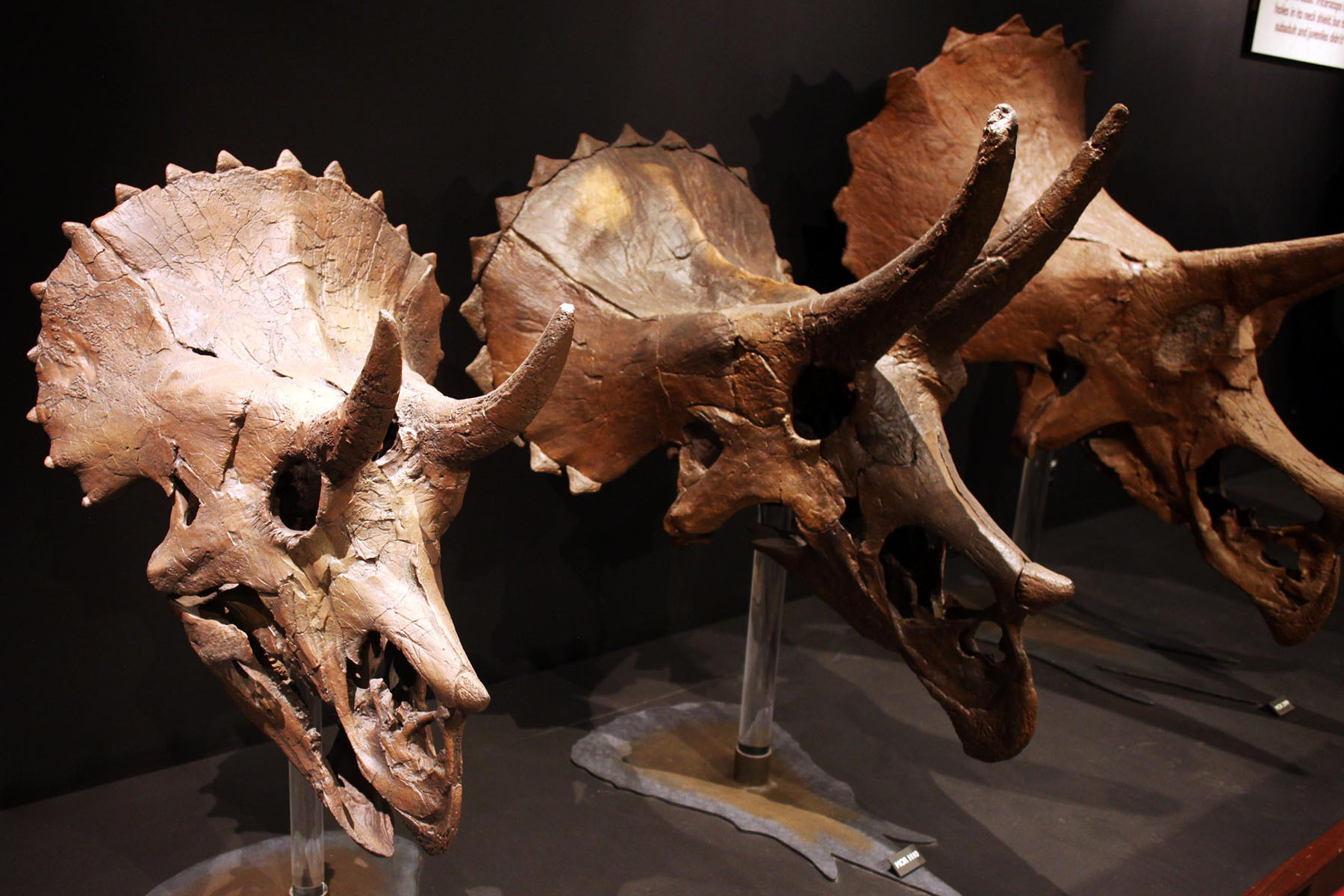
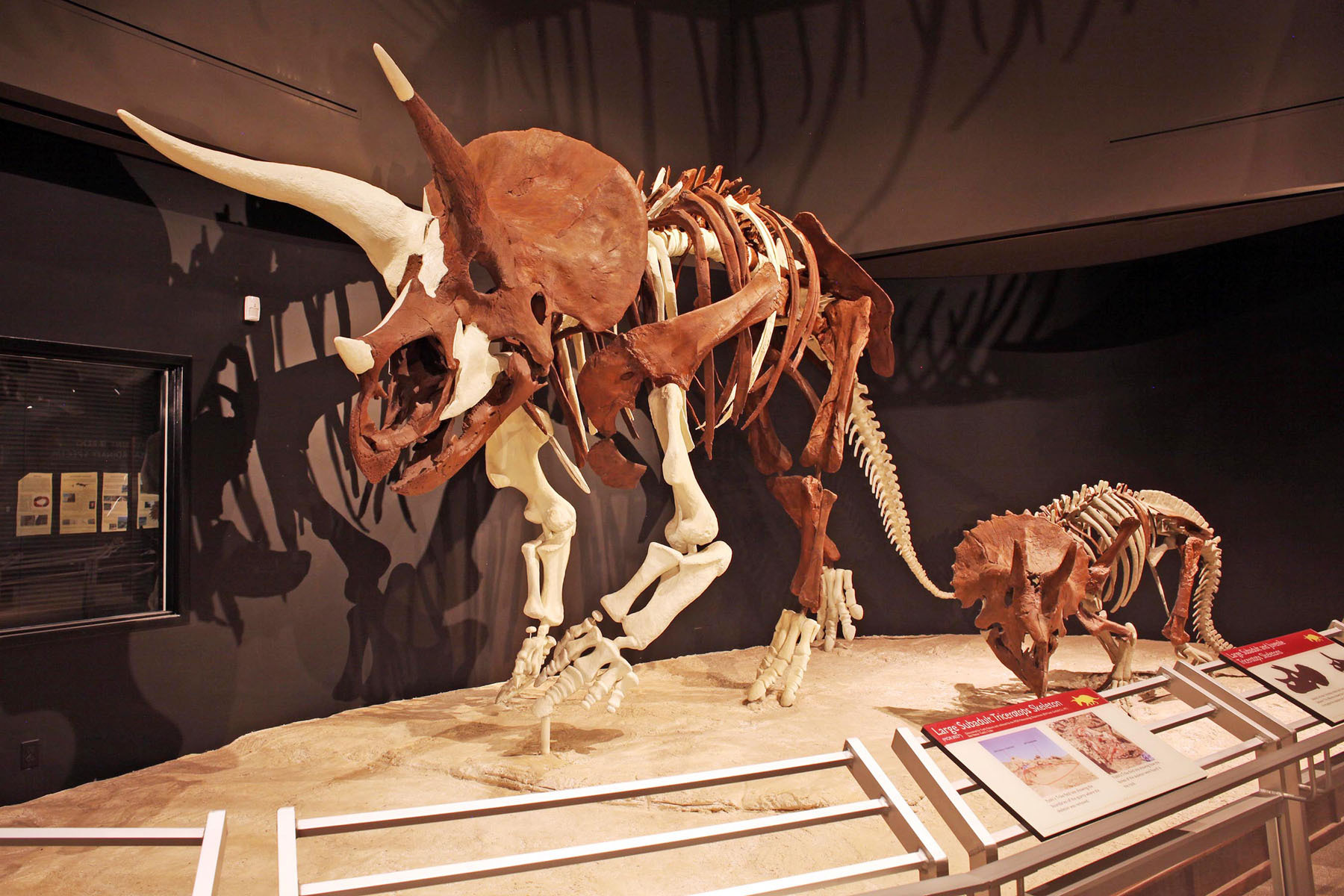
Explore one of the largest Triceratops collections, which reveals how this famous three-horned giant grew and evolved. From baby to behemoth, learn how MOR’s Triceratops discoveries have shed light on dinosaur biology, growth, and diversity. See Triceratops develop from baby to adult in a series of skulls, ending with one of the largest dinosaur skulls ever discovered! Skeletons of an adult and a juvenile Triceratops pace warily near Montana’s T. rex, and a tyrannosaur-bitten hip bone shows what happened when these animals got too close!

A series of Triceratops fossil skulls arranged in a row to demonstrate their growth stages, with each skull increasing in size and complexity from left to right.
Hall of Horns and Teeth Triceratops Growth Display
A comparative display in the Hall of Horns and Teeth featuring the large "Yoshi's Trike" Triceratops skeleton standing next to a significantly smaller juvenile Triceratops skeleton.
Hall of Horns and Teeth Yoshi's Trike + Juvenile
A close-up view of two massive Tyrannosaurus rex fossil skulls on display in the Hall of Horns and Teeth, showcasing the intricate bone structure and large teeth.
Hall of Horns and Teeth T. rex Skulls
A dramatic view within the Hall of Horns and Teeth at Museum of the Rockies, featuring the towering "Big Mike" T. rex skeleton looming over the smaller "Yoshi's Trike" Triceratops exhibit on the gallery floor.
Hall of Horns and Teeth Big Mike + Yoshi's Trike
A front view of the "Montana's T. rex" skeleton on display in the Hall of Horns and Teeth, showing the dinosaur in a dynamic pose above several informational plaques and lower display panels.
Hall of Horns and Teeth Montana's T. rex

Cenozoic Corriodor

Sixty-six million years ago, a mass extinction event ended the reign of the non-avian dinosaurs and brought the Mesozoic Era to an end. This marked the beginning of the Cenozoic Era, a time when mammals, a group of animals that had lived in the shadows of the dinosaurs for over 100 million years, came to dominate the Earth.

The Cenozoic Corridor highlights the fossils of mammals and other creatures that roamed Montana after the Age of Reptiles, including ancient horses, bison, mammoth, rhinoceros, and a bone-crushing dog.

CHECK US OUT ON INSTAGRAM

© 2025 Museum of the Rockies. All Rights Reserved. | Website Created By: PRIME

© 2025 Museum of the Rockies. All Rights Reserved.
Website Created By: PRIME